
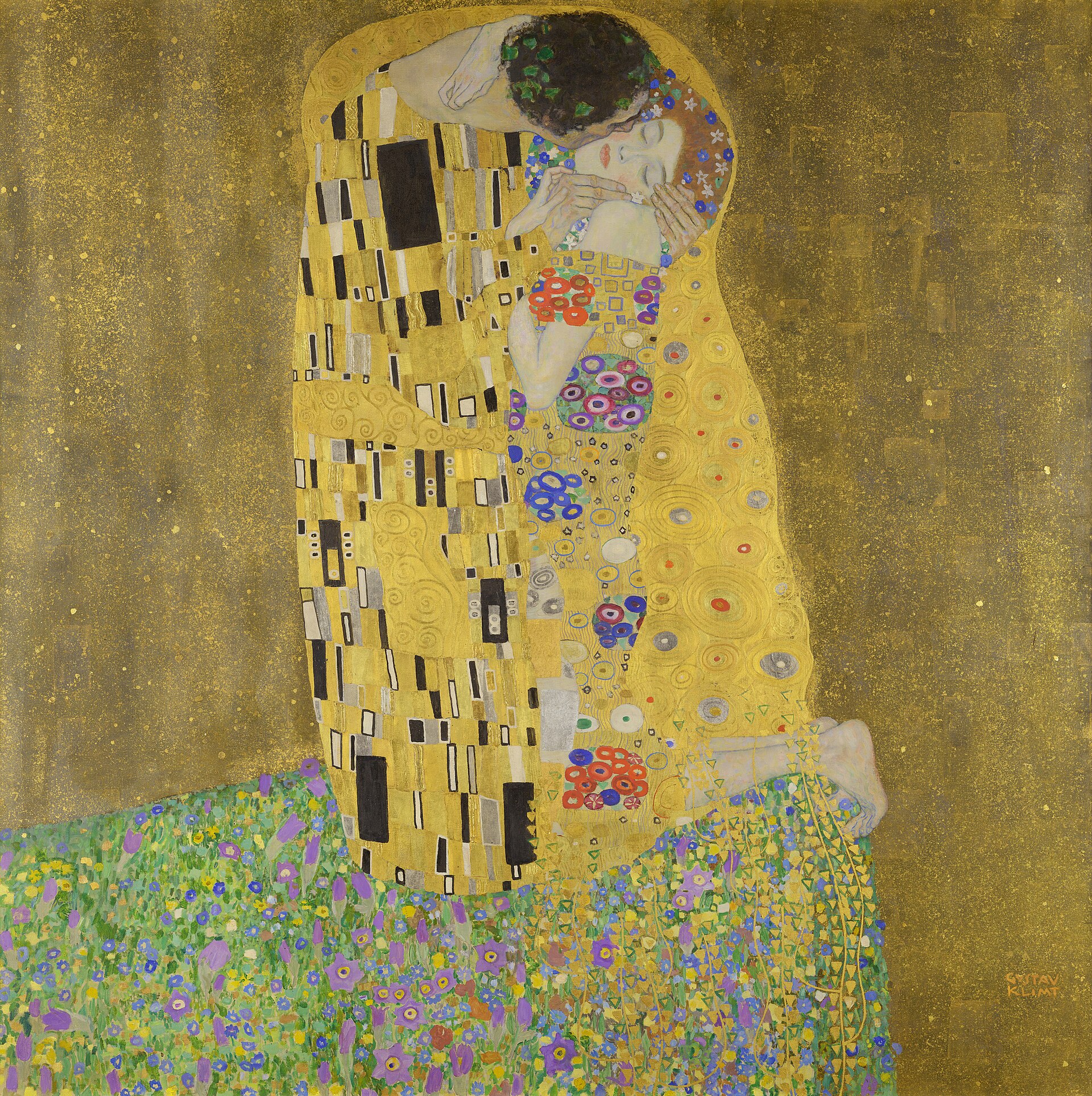
Gustav Klimt, The Kiss, 1907-1908.
Symbolism is an art movement that developed in Europe at the end of the 19th and the beginning of the 20th century, aiming to express the emotion, dream, mystery and spiritual meaning beyond visible reality through images. The movement manifested powerfully in both literature and painting and was born as a reaction against the naturalist and realist tendencies of its age. For the Symbolists, what mattered was not the outward appearance of an object or a figure, but the inner meaning it evoked. In this respect, the movement brought a new outlook that tied art to thought and intuition rather than observation.
How did Symbolism emerge?
Rather than depicting the world as it is, Symbolism seeks to suggest the hidden feelings and thoughts behind it. Instead of stating an idea directly, artists preferred to imply it through an image, a color or an atmosphere. This approach first became distinct in French literature, particularly poetry, toward the end of the 19th century, and soon spread to painting. The poets of the era, focusing on the evocative power of words rather than their dictionary meanings, also inspired painters.
At the movement’s core lies a skepticism toward the world that can be grasped by reason and observation alone. In an industrializing and increasingly materialistic age, the Symbolists believed that science and realism were neglecting the soul. They believed that the spirit, the imagination and the subconscious could be carried into painting. This is why abstract themes such as love, death, desire, dream and myth appear so often in their works. What is expected of the viewer is not to explain what they see, but to feel it. A work leaves its door open not to a single meaning, but to many interpretations.
What are the defining characteristics of Symbolism?
The most distinctive quality of Symbolist works is their mysterious, dreamlike atmosphere. Scenes are usually staged in a surreal silence, detached from time and place. Figures appear still, introspective and contemplative. The viewer encounters a state of mind rather than a concrete event.
Some of the movement’s key characteristics can be listed as follows:
- Emotion and thought taking precedence over reality
- Subjects drawn from sources such as myth, legend, religion and dream
- Color and form used as means of expression
- An ornamental, decorative visual language, at times enriched with precious surfaces such as gold
- Opposing emotions such as love and death, or desire and fear, treated together
With these characteristics, Symbolism does not adhere to a single visual style. Some artists adopted a soft, misty technique, while others worked with sharp lines and bright colors. What unites the movement is a mindset rather than a form. To recognize Symbolism, one must therefore look not at a technique but at the atmosphere a work carries and its mysterious layers of meaning.
Important artists and works
One of Symbolism’s leading figures is the Austrian painter Gustav Klimt. The Kiss, shown at the top of this article, is considered one of the works that best reflect the movement’s decorative and emotional side. In this painting, through the use of gold leaf, rich patterns and two embracing figures, Klimt depicts love as a moment that is both earthly and almost sacred. His Portrait of Adele Bloch-Bauer is likewise counted among the peaks of his ornamental style.
The French artist Gustave Moreau, who rendered mythological and religious scenes in rich detail, is considered one of the movement’s pioneers. He painted subjects such as Salome with a mysterious and magnificent atmosphere. Odilon Redon is known for his dreamlike, fantastical images, pushing the limits of imagination in his colored pastel works. The strange, dreamlike creatures in his charcoal drawings are like doors opening onto the subconscious.
The Norwegian Edvard Munch also carried Symbolist tendencies through an important part of his career, bringing the tensions of the inner world and existential anxiety into painting. His work The Scream became a universal image of this inner distress. The French Pierre Puvis de Chavannes, with his calm, quiet murals, exemplifies a more serene branch of the movement.
These artists never formed a common group or an official school. Yet they all shared the passion of searching for meaning beyond the visible world.
How did Symbolism influence later movements?
Symbolism’s influence extends beyond the limits of its own era. The movement’s decorative sensibility has a close relationship with Art Nouveau, which developed particularly around the turn of the century. Flowing lines, motifs taken from nature and the importance given to ornament found a wide place both in poster design and in the applied arts. The Vienna Secession, of which Klimt was a member, was an important setting where these two sensibilities met.
Symbolism’s emphasis on the inner world and emotion also prepared the ground for movements such as Expressionism, which emerged shortly afterward. The idea of turning reality into a vehicle of emotion, rather than showing it as it is, shaped a large part of 20th century art. The interest in the subconscious, in dreams and in symbolic narration resurfaces in later movements such as Surrealism. The path opened by the Symbolists permanently expanded art’s capacity to express the invisible.
Influence on later periods and today’s design
The symbolic language frequently used today in graphic design, illustration and brand communication traces its origins back to this sensibility. The idea that an image can say a great deal without stating it directly is one of the fundamental principles of contemporary visual communication. A logo often implies a brand’s values with a few lines; this is precisely Symbolist thinking reflected in design.
The use of decorative patterns, gold and metallic surfaces, and a visual language evoking luxury and mystery in poster and packaging design draws on Symbolism and the Art Nouveau tradition that developed alongside it. Especially in fields such as fashion, cosmetics and jewelry, brands turn to this symbolic language to present a product not as a mere object but as an object of emotion and desire. The interest in ornamental surfaces, textures and atmospheric lighting in interior design comes from the same root.
Even in digital design, the mood created by an interface or a campaign visual is often more powerful than an explicit message. In this respect, Symbolism can be seen not merely as a painting movement, but as a lasting perspective on how the visual carries meaning. The designer’s ability to use image, color and atmosphere as generators of meaning rests directly on the intellectual legacy this movement opened up.