
What is Art Nouveau?
Art Nouveau is an international art and design movement that spread across Europe and America roughly between 1890 and 1910, defined by its flowing lines inspired by nature. Its name is French for “New Art”, representing a search for renewal against the era’s habit of repeating historical styles. It is a total style that united many fields, including painting, architecture, graphics, jewelry, furniture, interior design, ceramics, textiles, metalwork and glass art, under a single visual language. In this respect, Art Nouveau is not merely a style of painting but a comprehensive design movement that aimed to beautify every object of daily life.
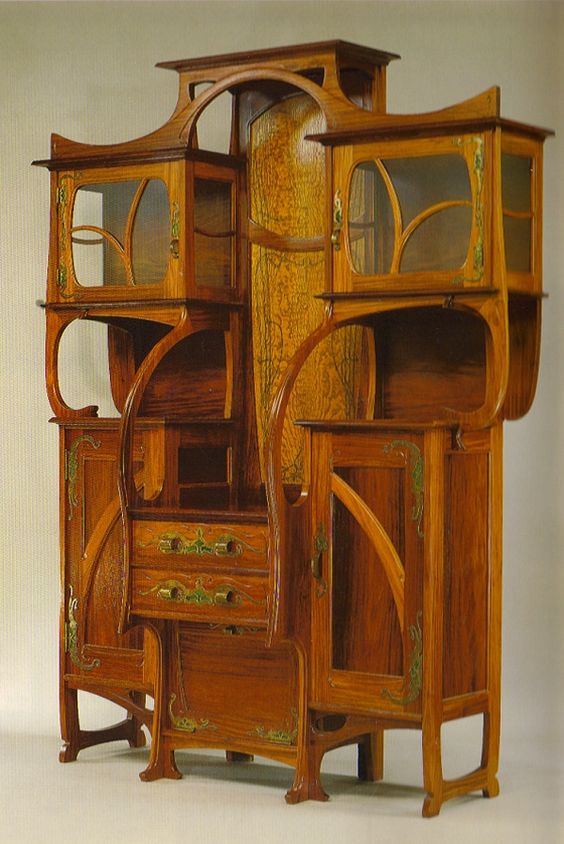
The movement appears under different names in different countries. It was known as Art Nouveau in France and Belgium, Jugendstil in Germany, Sezession in Austria, Stile Liberty in Italy and Modernismo in Spain. This diversity shows that the movement took on a local character in each country. The common thread is the desire to reinterpret the forms of nature rather than imitate them.
How did Art Nouveau emerge?
At the root of Art Nouveau lies a reaction to the mass production brought by industrialization at the end of the 19th century and to products that had drifted away from aesthetics. In England, the Arts and Crafts movement led by William Morris prepared the ground for this new sensibility by emphasizing the importance of craftsmanship and quality. In the same period, the growing trade between Europe and the Far East brought Japanese woodblock prints to Europe, and the plain lines and flat areas of color of these prints offered artists a new visual language. This interest in Japanese art is known as Japonism and was decisive in the birth of the movement.
Advances in printing technology also enabled the movement to spread rapidly. The art magazines that appeared after 1890 introduced Art Nouveau and its approach to design to wide audiences. The movement thus became an international phenomenon within a short time.
What are the characteristics of Art Nouveau?
The movement’s most distinctive signature is the long, undulating, energetic line known as the “whiplash line”. These lines recall vines, flower stems and women’s hair. Flowers, leaves, swans, butterflies and graceful female figures are the most beloved motifs. Organic, flowing forms are preferred over symmetry and strict geometry.
In Art Nouveau, ornament and function are inseparable. A stair railing, a door handle or a glass panel forms a whole that is both functional and decorative. Materials such as cast iron, curved glass and ceramics are used frequently because they allow flowing lines to be realized. Structure, decoration and function are considered together. This holistic approach is the most important quality connecting the movement to the modern design thinking that was to come.
Important artists and works
Art Nouveau produced powerful figures across different branches.
Victor Horta, the Belgian architect, is the movement’s pioneer in architecture. The Tassel House and the Hôtel Solvay in Brussels are landmark buildings in which cast iron is used with flowing lines.
Hector Guimard is famous for designing the entrances to the Paris Métro. His iron entrances, reminiscent of plant stems, are among the movement’s most publicly recognized symbols.
Antoni Gaudí brought his own organic interpretation to the movement in Barcelona with buildings such as Casa Batlló and the Sagrada Família.
Alphonse Mucha, the Czech-born artist, was the master of poster design. His posters for the actress Sarah Bernhardt and his series “The Seasons” defined the movement’s graphic language.
Louis Comfort Tiffany carried the movement into the decorative arts in America with his stained glass and lamps. Tiffany lamps are still considered iconic today.
René Lalique was the master who brought Art Nouveau elegance to precious objects through jewelry and glass design.
How was Art Nouveau reflected in Turkey?
The movement reached Istanbul at the end of the 19th century, appearing especially in the mansions, waterfront houses and apartment buildings around the Bosphorus. The Italian architect Raimondo D’Aronco was the most important figure to bring the Art Nouveau style to Istanbul, combining the movement’s lines with elements of Ottoman architecture. The principal buildings in Istanbul bearing traces of the movement are:
Şeyh Zafir Tomb in Beşiktaş
Botter Apartment in Taksim
The Italian Embassy in Tarabya
The Egyptian Consulate Waterfront House in Bebek
Ahmet Ratıp Pasha Mansion in Acıbadem
Vlora Han in Sirkeci
Huber Mansion in Yeniköy
Mısır Apartment in Taksim
Çubuklu Pavilion in Beykoz
Faik and Bekir Bey Waterfront House in Yeniköy
These buildings are valuable examples of how this new Western style was adapted to the Ottoman capital.
Influence on later periods and today’s design
Although Art Nouveau fell out of favor with the First World War, its influence proved far longer-lived. The movement’s nature-inspired approach to form and its integration of ornament with function opened the way for Art Deco and modernist design that followed. Making structure clearly visible and respecting the natural qualities of materials became fundamental principles of modern architecture.
In graphic design, the movement’s legacy is particularly strong. Flowing lines, decorative typography and the integrated frame continue to inspire today’s logo, packaging and poster designs. The psychedelic concert posters of the 1960s drew directly on Art Nouveau’s curving letterforms and vivid colors. The movement’s trace can also be seen in the return of organic forms, curvilinear furniture and natural motifs in interior design. Objects such as Tiffany glass and Lalique designs remain classics that are still produced and prized. In this respect, Art Nouveau served as a critical bridge in the birth of modern design, carrying the idea of uniting nature and aesthetics into the present.
Source: