
What is Art Deco?
Art Deco is a decorative art and design movement that was influential worldwide in the 1920s and 1930s, defined by its geometric forms, symmetrical order and luxurious materials. Its name comes from the Exposition Internationale des Arts Décoratifs et Industriels Modernes, held in Paris in 1925. It influenced an extraordinarily wide field, from the visual and decorative arts to fashion, from architecture to cinema and product design. The most fundamental quality that sets Art Deco apart from similar movements is its orientation not toward the past, but toward the future and modern progress.
The movement drew on the avant-garde painting movements of the early 20th century. The fragmented forms of Cubism, Futurism’s admiration for speed and the machine, and the geometric language of Constructivism and Suprematism make up Art Deco’s visual vocabulary. For this reason Art Deco is sometimes called “domesticated Cubism”. The movement created a synthesis of its own by combining these modern sources with a luxurious, decorative sensibility.
How did Art Deco emerge?
Art Deco first took shape in France, in Paris, in the 1920s. It spread rapidly in the optimistic, glamour-loving atmosphere that followed the First World War and became the most popular design language of the interwar period. Designers searched for exotic sources that would suit their geometric sensibility, and this search produced a rich repertoire of motifs from the art of ancient Egypt, Mesopotamia, Asia, Africa and Central America. The discovery of Tutankhamun’s tomb in 1922, in particular, heightened the interest in Egyptian motifs. Art Deco thus became the first truly global decorative movement.
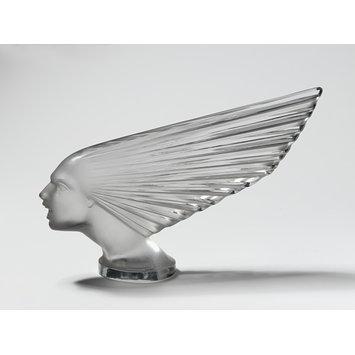
Victoire (1928), Artist: René Lalique
What are the characteristics of Art Deco?
The Art Deco style is defined by straight lines reflecting modern technology, geometric shapes, streamlined forms and bright, at times striking colors. Zigzags, stepped arrangements, trapezoids, sunburst patterns and interlocking angular motifs are the most frequently seen forms. Symmetry and order are the movement’s fundamental principles.
The movement began with a sensibility of luxury. In its early period, precious materials such as silver, crystal, ivory, ebony, jade and lacquer were used. Exotic materials such as sharkskin and zebra skin were also favored. After the economic crisis of 1929, more affordable and modern materials such as chrome, aluminum, glass, steel and plastic came to the fore.
What is the difference between Art Deco and Art Nouveau?
Both movements value strong ornamentation and decorative richness, but their visual languages are opposites. Art Nouveau draws on nature; it uses curvilinear, flowing, botanical forms. Art Deco takes its inspiration from industrialization and technical progress; it is geometric, sharp and symmetrical. Art Deco is also compared with the Bauhaus. Although both rest on geometry, the Bauhaus championed simplicity and functionality, while Art Deco preferred luxury, ornament and display. In this respect Art Deco represents the more decorative and ornate wing of modernism.
Important artists and works
Art Deco produced prominent figures across different disciplines.
René Lalique was the master of glass design. His car mascot “Victoire” and his decorative glass panels symbolize the movement’s elegance.
Tamara de Lempicka is the best-known name in Art Deco painting. Her sharp-edged, glossy, modern portraits reflect the spirit of the era.
Jean Dupas defined the movement’s visual language with his posters and decorative panels; Erté did so through fashion illustration and stage design.
In architecture, William Van Alen produced the movement’s most iconic building with the Chrysler Building in New York. With its stepped steel crown, the building is considered a symbol of Art Deco. Rockefeller Center and the Empire State Building are also important structures bearing the movement’s traces. New York’s Radio City Music Hall is a magnificent example of the movement in interior design.
How was Art Deco reflected in architecture?
In the United States, Art Deco expressed itself most widely in architecture. The 1922 Chicago Tribune skyscraper competition was an important turning point in the movement’s arrival in America. The stepped silhouettes of skyscrapers, their geometric ornamentation and grand entrances became the movement’s signature. The architecture reinterpreted, in a modern language, the mathematical and geometric order taken from the buildings of ancient Egypt, Babylon, Assyria and the Aztecs. Examples of the movement were not confined to America; it spread to many countries including the United Kingdom, Spain, Cuba, Argentina, Australia, India and Brazil. In Istanbul, buildings such as the Mısır Apartment in Beyoğlu also bear the traces of this style.
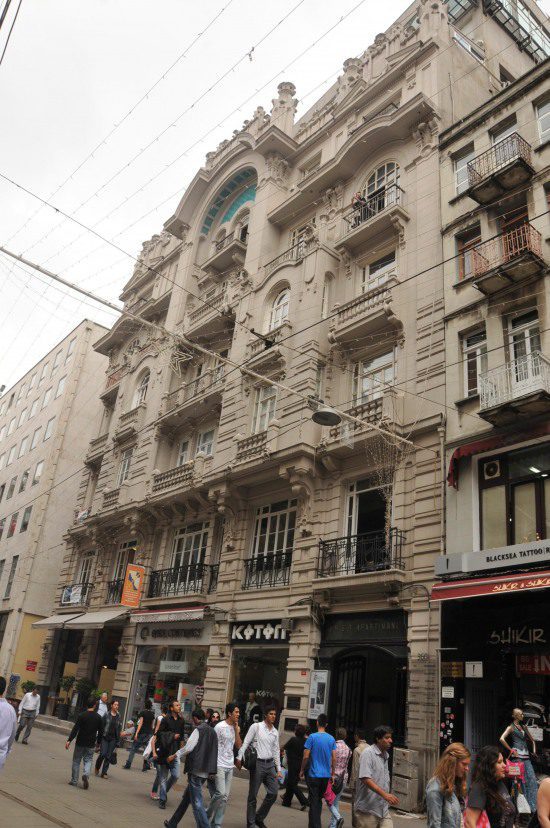
Mısır Apartment, Beyoğlu
Influence on later periods and today’s design
Although Art Deco lost its popularity for a time after the Second World War, it revived in the 1960s along with consumer culture. Its global visual language and its suitability for mass production carried its legacy into the present. Today, the movement’s geometric order and connotations of luxury appear frequently in brand identities, logo designs, and hotel and cinema interiors. In the worlds of jewelry and fashion, Art Deco-inspired collections are regularly reproduced.
The movement’s influence in popular culture is also strong. Films, series designs and productions such as “The Great Gatsby” in particular have reintroduced the Art Deco aesthetic to wide audiences. In graphic design, zigzag, sunburst and stepped motifs are still used to evoke elegance and glamour. Art Deco societies and preservation associations continue to work on the restoration of the monumental buildings erected during the movement’s golden age. Art Deco thus lives on both as a nostalgic language of luxury and as one of the sources of inspiration for modern design.
Sources: