
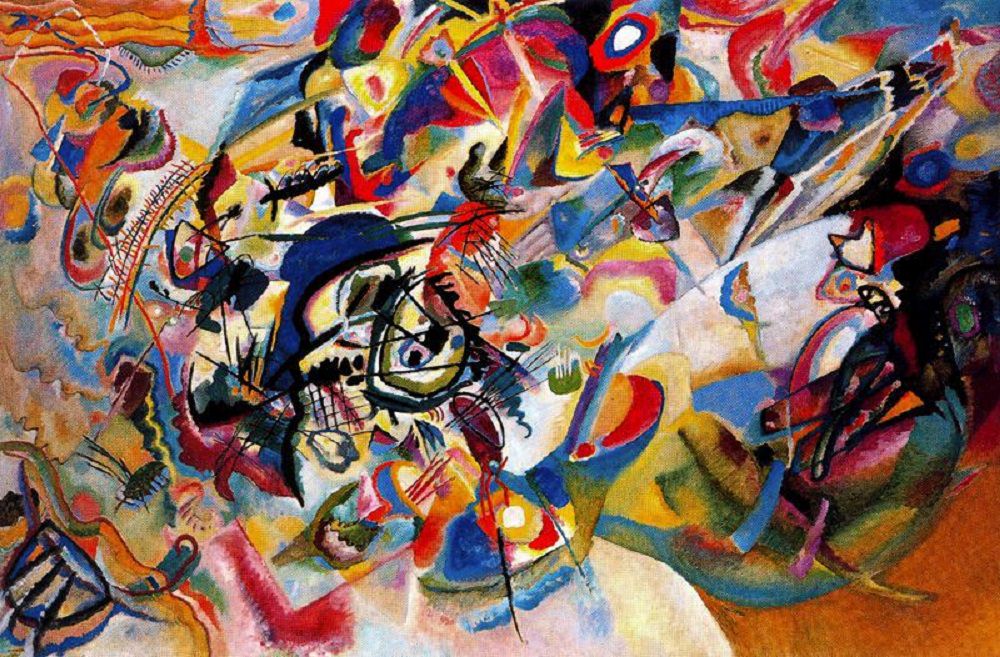
Wassily Kandinsky, Composition VII, 1913.
Abstract art is an art movement that developed in Europe at the beginning of the 20th century, aiming to build meaning through fundamental visual elements such as color, form, line and texture rather than depicting the visible world literally. In this approach, a work does not have to show a recognizable object from the outside world. Art becomes a language of expression in its own right, conveying emotion, rhythm and thought to the viewer. Abstract art represents a decisive break from the centuries-old tradition of imitating reality and set in motion one of the most profound transformations of modern art.
What is abstract art?
The fundamental idea of abstract art is the liberation of painting from its duty to imitate reality. For centuries, art had tried to show the objects, people and landscapes around it as realistically as possible. Abstract art reverses this expectation. What matters here is not what the subject is, but what effect the colors and forms create together. There is no need to search for any object in a work, because meaning is built directly in the visual elements themselves.
This understanding gained strength with the spread of photography and the development of modern thought. Once the camera could record reality far more quickly and accurately, painters realized that this task no longer belonged to them. As artists saw that they could leave the recording of reality to other tools, they turned to exploring the possibilities unique to painting. Abstraction sometimes starts from a recognizable object and gradually simplifies it, and sometimes rests entirely on independent forms without any external reference.
What are the characteristics of abstract art?
The most distinctive characteristic of abstract art is the absence of recognizable objects, or their profound transformation. Works mostly consist of patches of color, geometric shapes, free lines and textures. Instead of a landscape or a portrait, the viewer encounters a visual arrangement that carries meaning on its own.
Among the movement’s key characteristics are the following. Color is used to create an emotion or atmosphere directly, rather than to describe an object. Forms are sometimes sharp and geometric, sometimes fluid and organic. Concepts such as balance, rhythm and contrast come to the fore in composition. Many artists drew connections between music and painting, pursuing a visual harmony or accord. Music’s ability to convey emotion without depicting any object was an important source of inspiration for abstract artists.
Over time, abstract art branched into different directions. On one side developed an approach based on geometric, ordered forms; on the other, a more instinctive, free and emotional mode of expression. These two strands represent both the rational and the intuitive face of the movement.
Important abstract artists and works
Among the pioneers of abstract art, the most frequently cited name is the Russian-born artist Wassily Kandinsky. Kandinsky believed that color and form could speak directly to emotion, just like music, and developed this idea both in his works and in his writings, notably Concerning the Spiritual in Art. His Composition VII, shown above, is regarded as one of his best-known and most complex abstract works, with its intense colors and interlocking forms.
Other important figures in the movement’s development include the Dutch artist Piet Mondrian and the Russian artist Kazimir Malevich. Mondrian developed a serene, ordered geometric language based on horizontal and vertical lines and a limited number of primary colors. Works of the type of Composition with Red, Yellow and Blue are the most recognized examples of this purified order. Malevich, reducing art to its most elemental state, turned to the pure power of simple geometric forms, pushing the limits of abstraction with audacious works such as Black Square. The Czech-born František Kupka is also counted among this pioneering generation for his early abstract works exploring the rhythm of color.
What are the branches of abstract art?
Abstract art is not a single style but a broad field encompassing very different pursuits. Geometric abstraction is built on clean lines, flat areas of color and a measured order. Mondrian and Malevich are powerful representatives of this strand.
Lyrical or free abstraction, by contrast, is more instinctive and emotional. Here the gesture of the brush, fluid forms and spontaneously developing compositions come to the fore. In later years, Abstract Expressionism, which developed in America, carried this free strand onto large-scale, energetic canvases. This diversity shows that abstract art is a rich field where both disciplined and free structures can coexist.
How did abstract art influence later periods and today’s design?
The influence of abstract art extends far beyond painting. The simplicity, balance and order introduced by geometric abstraction in particular shaped the fundamental principles of modern graphic design and typography. A limited number of colors, clean lines and balanced use of empty space are still among the cornerstones of strong, effective design today. The grid systems and compositional principles taught in modern design education are directly related to this visual thinking.
Mondrian’s grid arrangements and blocks of color have echoed across a wide range of fields, from architecture to furniture design, from poster work to digital interfaces. The column-based layout of a web page or an app today, the balanced placement of content blocks and restrained color palettes are contemporary extensions of the sense of order that abstract art established. The clean, geometric logos of brands also often rest on this same logic of simplification.
By treating color and form as independent means of expression, abstract art showed designers that visual order itself carries a message, even before content. Today abstract art is regarded as one of the most enduring and influential strands of modern art. This bold step, which freed art from imitation, gave both subsequent art movements and the language of contemporary design a lasting space of freedom. The idea that good design should say much with few elements draws largely on this heritage.