
What is the Arts and Crafts movement?
Arts and Crafts is a design and art movement born in England in the second half of the 19th century, defending craftsmanship and the value of quality against mass production. The movement emerged as an answer to the social and aesthetic problems created by the Industrial Revolution. Its stance against industrialization, a socialist outlook and respect for manual labor are among its most fundamental qualities. It embraced a plain, honest, nature-inspired style across many fields, including furniture, textiles, wallpaper, ceramics, book design and architecture.
Industrialization brought a great influx of workers into the cities, where they labored long hours in dangerous jobs for low wages and lived in unhealthy housing. The spread of factories polluted the urban air. Arts and Crafts rose as a reaction both to these working conditions and to the shoddy, over-ornamented objects produced in the factories.
How did the Arts and Crafts movement emerge?
The movement’s intellectual foundations lie in the criticism of figures such as John Ruskin and the architect Augustus Welby Northmore Pugin. Ruskin argued that industrialization was turning the worker into a machine and destroying the soul of art. For both Ruskin and Pugin, there was a tight bond between a society’s morality and its architectural form. In their view, objects made honestly and by hand were both more beautiful and more moral.
The first spark for the movement was the Great Exhibition, held in London in 1851 as the world’s first great international fair. The pointless, dysfunctional ornamentation of the factory products on display was sharply criticized by the thinkers of the day. This criticism prepared the ground for the birth of a plain and honest approach to design.
How did William Morris shape the movement?
William Morris, influenced by Ruskin’s views, is the figure at the movement’s center. A student of the architect George Edmund Street, Morris was influenced by the Pre-Raphaelite painters, whose circle included Edward Burne-Jones and Dante Gabriel Rossetti. In 1861 Morris founded the decorative arts firm Morris, Marshall, Faulkner & Co. together with Philip Webb, Burne-Jones, Rossetti, Charles Faulkner, Ford Madox Brown and Peter Paul Marshall.
The Red House, designed for Morris by the architect Philip Webb in 1859, is considered the movement’s first important building. Named after the color of its bricks, the house embodies the movement’s principles with its asymmetrical plan, plain brickwork and honest construction. Morris’s firm grew through the 1860s and 1870s, broadening its range with products such as furniture, the famous Morris chair, textiles and stained glass. In 1875 the firm was reorganized and took the name Morris & Co.
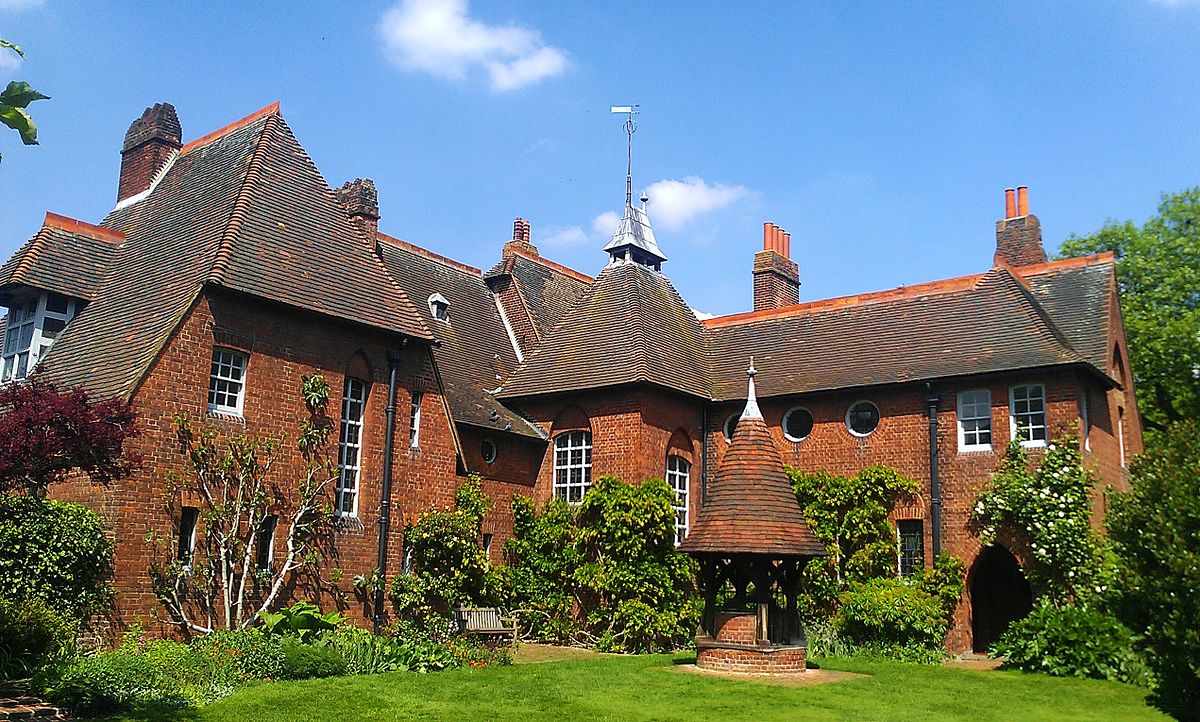
William Morris’s Red House in London designed by Philip Webb.
Morris’s firm emphasized handmade products in opposition to machine production. Morris dreamed of creating a kind of democratic art through quality workmanship and of improving workers’ conditions. He championed the use of organic dyes and defended production based on natural resources. The popularity of his work grew steadily in Britain, continental Europe and the United States.
Important artists and works
The movement’s most important figure is William Morris, both designer and thinker. His wallpaper and textile patterns such as “Strawberry Thief” and “Trellis” are classics still in production today.
John Ruskin is regarded as the movement’s intellectual father, shaping its philosophy through his writings.
Philip Webb produced the movement’s first architectural example with the Red House.
Edward Burne-Jones added artistic depth to Morris’s firm with his stained glass and illustration designs.
In America, Gustav Stickley interpreted the movement with his plain, solid oak furniture, while the architect Charles Rennie Mackintosh carried it into a distinctive direction of his own in Scotland.
What are the characteristics of the Arts and Crafts movement?
The natural quality of the materials used is emphasized and preserved. The most distinctive characteristic is simple form; unnecessary and showy ornament is avoided. The essential character of the object comes first. The most beloved motifs are inspired by nature, by the plant and animal life of the British countryside. Local traditions and handcrafts are the principal sources of inspiration. Workshops were mostly established in rural areas, where old techniques were revived and practiced.
Furniture is wooden and handmade; the most commonly used wood is oak. Copper and leather details complete the ethos of honest construction. Floors are usually polished oak or parquet. Color choices run to warm, natural tones such as cream, brick red, mustard yellow, olive green, dark blue and dark red. Walls may be wood-paneled or painted in soft green tones. Wallpapers are made with organic dyes and woodblock printing. A large fireplace is the focal point of the house. Stained glass windows appear frequently in this style for the medieval air they lend.
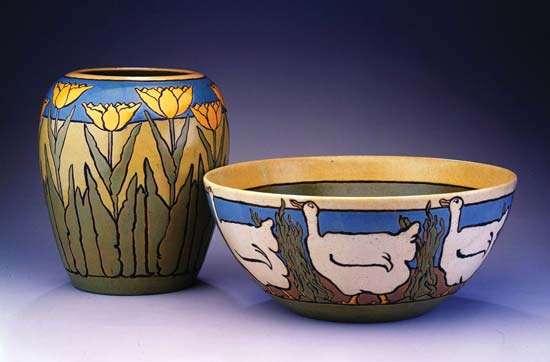
Vase and Bowl from the Paul Revere Pottery
Influence on later periods and today’s design
In the 20th century, several factors reduced the reach of the Arts and Crafts movement. The most fundamental problem was that handmade products required intensive labor and therefore could never be cheap enough for wide audiences to afford. This contradiction between Morris’s dream of a democratic art and the high cost of handcraft was never fully resolved, and the movement gradually came to serve only wealthy clients.
Even so, the movement’s legacy is remarkably strong. The value it placed on handcraft, honest materials and plain form directly influenced the modern design that followed. In Germany, the Bauhaus school inherited its philosophy of “function and honest design” from this movement. The philosophy of Arts and Crafts also inspired the birth of Craftsman-style houses and furniture in America.
Today the movement’s influence is livelier than ever. William Morris patterns are still produced as wallpaper and textiles and attract great interest. The handmade product movement, the emphasis on local and sustainable production, and the “slow design” ethos draw directly on Arts and Crafts principles. The interest in quality, labor and natural materials, as a counter to the uniformity created by mass production, shows that the ideas Morris championed a century and a half ago remain valid today.
Source: