
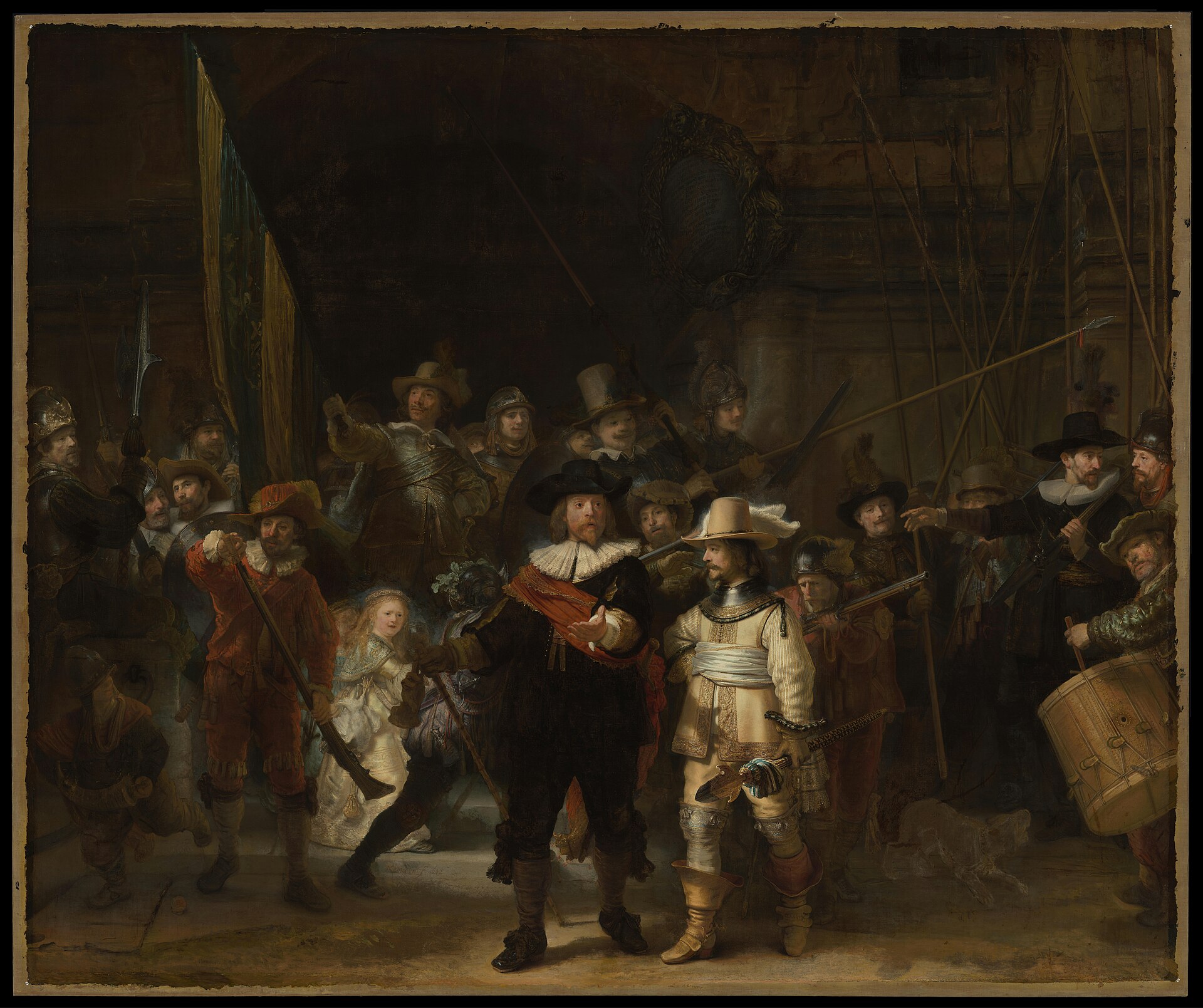
Rembrandt, The Night Watch, 1642.
Baroque is a grand art movement that developed in Europe in the 17th century, built on movement, light and emotional intensity. Coming after the calm balance of the Renaissance, Baroque aimed to impress the viewer, draw them into the scene and stir a powerful emotion. Spreading across a wide field, from painting to architecture, from sculpture to music, this style reflects the exuberant and ostentatious spirit of its era. According to some sources, the word derives from a term describing an irregularly shaped pearl, and it was initially used as a label emphasizing excess.
What is Baroque and under what conditions was it born
Baroque is an artistic outlook that shaped much of Europe throughout the 17th century. In this period, art aimed less to leave a serene impression than to stir a strong and immediate emotion in the viewer. Religious scenes, historical events and portraits were treated with dramatic tension and vitality. The viewer was no longer positioned as a distant observer but as a witness who feels the tension of the scene in their own body.
The movement was nourished by the pursuit of grandeur in both the church and the courts. The Catholic Church in particular used art as an instrument of persuasion, to convey faith in a powerful and compelling way. Large-scale buildings, rich ornamentation and impressive ceiling paintings became the visual language of power and belief. The courts adopted the same theatrical language to display the splendor of absolute rule. Baroque thus became the shared mode of expression for both religious fervor and political power.
Baroque art seeks to turn the viewer from a passive observer into someone who feels part of the scene. In this respect, it is a pursuit of an immersive experience that orchestrates space, light and movement as a single whole.
What are the defining characteristics of Baroque art
The most distinctive feature of Baroque art is the strong contrast between light and shadow. In this technique, known as chiaroscuro, artists lit certain parts of the scene while leaving others in darkness, creating both a dramatic emphasis and a deep sense of space. Tenebrism, developed by Caravaggio, pushed this contrast to its extreme, pulling figures out of dense darkness with a single beam of light.
The movement’s key qualities can be summarized as follows:
- Dynamic compositions that evoke a sense of movement and energy.
- Strong modeling based on the sharp contrast of light and shadow.
- Lively scenes built on diagonal lines and swirling arrangements.
- A pronounced emotional intensity in facial expressions and gestures.
- Rich texture, magnificent detail and a theatrical presentation.
The Night Watch brings many of these characteristics together. In this scene, where figures move in different directions and light falls on particular individuals, the painting goes beyond an ordinary group portrait to create the feeling of a living, moving moment. Instead of a rigid, orderly arrangement, Rembrandt builds a bustling crowd governed by light.
Who are the important Baroque artists and works
The Baroque period is remembered for powerful and original figures. Caravaggio is regarded as a pioneer who used the contrast of light and shadow in striking ways and gave his scenes a strong sense of reality. In works such as The Calling of Saint Matthew, he placed ordinary people inside a sacred moment, lending religious scenes a surprising intimacy.
Rembrandt stands out for his mastery in using light as a narrative tool. In The Night Watch and countless self-portraits, he conveys human emotion with deep sincerity. Peter Paul Rubens represents the exuberant side of Baroque with his dynamic compositions, full-bodied figures and energetic storytelling. Diego Velázquez, in his painting Las Meninas, depicted court life with masterful observation and a refined sense of light, becoming one of the most respected names of the period.
Alongside these masters, in sculpture Gian Lorenzo Bernini produced one of the most powerful expressions of the Baroque with works that turn marble into a moment frozen in motion. Works such as the Ecstasy of Saint Teresa are considered the pinnacle of emotion and movement carved in stone. In France, Nicolas Poussin represented a more measured and classical interpretation of the Baroque, while the splendor of Italian ceiling painting also reflects the shared spirit of the era. Though these artists had very different personalities, they met in a common pursuit of drama and vitality.
How did Baroque influence today’s design and later periods
Baroque’s powerful light contrast and its approach to directing attention left a lasting mark as one of the fundamental tools of visual storytelling. The idea of highlighting the most important element of a scene with light and drawing the eye to a specific point is still very much alive in photography, cinema and stage design today. Concepts such as emphasis, contrast and hierarchy in contemporary design thinking also draw on this legacy.
Cinema in particular owes a great deal to Baroque lighting. The dark, sharply lit scenes of the film noir genre are a direct continuation of chiaroscuro aesthetics. Illuminating a character in darkness with a beam of light, or using light deliberately to underscore a dramatic moment, remains a language that both directors and photographers turn to today. The balance of soft side light and hard shadow used in product and interior photography also carries traces of this tradition.
Baroque’s theatrical mode of presentation left its mark through its methods of impressing the viewer and provoking an emotional response. From brand experiences to stage design, from shop window displays to attention management in digital interfaces, the idea of drawing the eye to a focal point and constructing a magnificent whole lives on across many fields. Dramatic lighting and rich texture in interior architecture are also contemporary reflections of the Baroque sensibility.
The styles that followed the Baroque sometimes turned toward a plainer order in reaction to this exuberance, and sometimes carried its ostentatious energy forward in different forms. Rococo, which came immediately after, lightened the weight of the Baroque and translated it into an elegant, playful language. In the end, Baroque redefined art as a spectacle and an experience of emotion. Masterfully using light, movement and tension, this movement continued to be one of the most impressive expressions of visual culture, both in its own time and afterward.