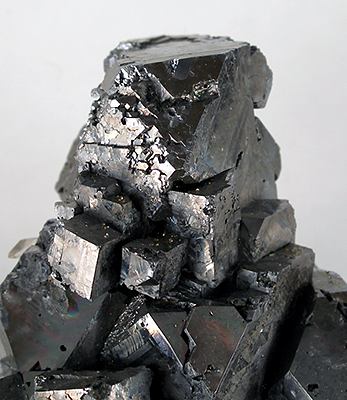
Lead (Pb)
Lead is an element found in group IV A of the periodic table, with a bluish light gray color. It rarely occurs free in nature, and is mostly found combined with other elements. Soft and ductile, lead is easy to work and can readily be shaped by hammering, but it is a metal with low mechanical strength. For this reason, it is mostly used as an alloy with other metals, which allows its mechanical properties to be improved. The softest and heaviest of the commonly known metals, lead is a high-density, inexpensive material. Its high density also gives lead resistance to radiation. Highly resistant to wear, corrosion and chemicals (such as sulfuric acid), lead is at the same time a toxic metal. Its use in many areas has been banned because of its harm to human health, and it sees little use in everyday life.
What made lead so widespread throughout history?
Lead is one of the oldest metals worked by humanity. The main reasons are that its ore, galena (lead sulfide), is easy to find, and that lead melts at a low temperature; this meant the metal could be extracted and cast even in simple furnaces. Its softness and ease of shaping made it convenient for producing pipes, sheets and vessels. The Romans used lead pipes extensively in their aqueducts and urban water networks; indeed, the words for plumbing in some European languages share a root with lead’s Latin name, plumbum. Its low cost, durability and workability kept lead attractive for centuries, while the harm it caused to health mostly went unnoticed.
Why is lead now withdrawing from everyday life?
Lead’s greatest problem is that it accumulates in the body and has no biological function whatsoever. Even low-level, long-term exposure can damage the nervous system, the kidneys and blood formation; children in their developmental years are especially sensitive to these effects. For this reason, from the second half of the twentieth century onward, lead was removed step by step from drinking water pipes, household paints, gasoline and toys. In the electronics sector, traditional leaded solders have largely been replaced by lead-free alloys. From a design perspective, this is an important example showing that material selection is determined not only by technical performance, but also by human health and the environmental life cycle.
Where is lead still used today?
Despite the bans, lead remains an important material in areas where alternatives are difficult. The best-known example is radiation shielding around X-ray equipment and nuclear facilities; lead’s high density allows it to stop high-energy rays within a small thickness. Hospital X-ray aprons and wall linings rely on this principle. Lead-acid batteries are still common in automotive and backup power systems; the high recycling rate of these batteries offsets their environmental impact to some extent. Lead also continues to be used in counterweights and some sound insulation applications, where its weight and vibration-damping property are useful.
Where lead is used
Areas of use:
Scale and balance weights
Nuclear reactors
X-ray generators and gamma ray sources (as protective shielding)
Water pipes
Roof cladding
Chemical industry
http://tr.wikipedia.org/wiki/Kur%C5%9Fun
https://www.nkfu.com/kursun-nedir-kursun-elementinin-ozellikleri/
http://www.nuveforum.net/1225-elementler/62768-kursun-kursunun-ozellikleri-kullanimi/