
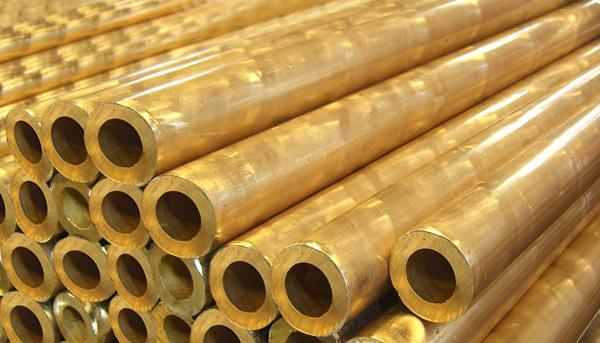
Brass is a yellow, easily workable material that is an alloy of copper and zinc. The proportion of copper in brass determines the material’s workability. Brasses containing more than 62% copper can be cold worked without requiring hot working and are called alpha brasses; they are generally used to make bolts, pins and screws. Beta brasses, containing less than 55% copper, are not easy to work. Although they require hot working to be shaped, they are more durable and are used to make products such as tap valves, door and window handles. Small amounts of other elements can be added to the alloy to improve the main properties of brass. Adding lead to plain brass improves machinability; adding manganese, silicon, nickel or iron improves yield strength; adding aluminum, arsenic or tin improves corrosion resistance (especially against seawater). In this way, by adding different elements such as tin, lead and aluminum, a class known as special brasses is obtained.
What determines the color and properties of brass?
The characteristic yellow color and mechanical behavior of brass are directly related to the ratio of copper and zinc it contains. Alloys with a high copper content are more reddish and softer; as the zinc content increases, the color shifts to a lighter yellow and the material hardens. This is why brass is not a single material but a family of alloys that can be tuned for different purposes by changing the proportions. The structure zinc forms with copper makes the alloy both castable and machinable. Properties such as brass’s low coefficient of friction and the fact that it does not produce sparks make it especially valuable in valves, bearings and fasteners. Its natural antimicrobial effect, owing to its copper content, has also been a historical advantage on frequently touched surfaces such as door handles.
Classification of brass
Brass materials can be classified as follows.
-Normal (Plain) Brasses
- Alpha Brasses
- Beta Brasses
-Special Brasses
- Leaded Brasses
- Tin Brasses
- Aluminum Brasses
- Manganese Brasses
- Nickel Brasses
- Silicon Brasses
- Iron Brasses
What is the difference between alpha and beta brasses?
The most fundamental distinction determining how brass is worked is the crystal structure that emerges depending on the zinc content. Alpha brasses, with a high copper content, have a single-phase structure; they can be cold forged, bent and are suitable for forming processes such as deep drawing. This is why thin sheets, cartridge cases, jewelry and decorative parts are generally made from alpha brass. Beta brasses, with a higher zinc content, are harder and more durable due to their two-phase structure, but they are difficult to cold work, so they are shaped by hot forging or casting. Valve bodies and structural fittings mostly fall into this group. For the designer, this distinction directly affects how a part will be produced, by which method it will take shape, and how durable it will be in the final product.
Uses of brass
Areas of use;
Door handles
Faucets
Sinks
Applications requiring strength
Why is brass preferred in design?
Brass has earned a lasting place in design because it offers functional and aesthetic value together. Its warm, gold-like color makes it a favorite in jewelry, lighting, furniture details and architectural accessories; the patina that forms over time is regarded by many designers not as a flaw but as a feature that adds character to the material. Functionally, its ease of casting and machining allows complex forms to be produced with precision. Its relative resistance to corrosion, and the fact that it does not rust since it contains no iron, ensures long life in products that come into contact with water, such as fixtures and valves. That said, designs that want to preserve a bright surface are finished with polish or a protective lacquer layer to slow tarnishing. Its warm touch and recyclability also place brass among sustainable material choices.
Source: