
Dieter Rams was born on May 20, 1932, in Wiesbaden, Germany. Influenced by his carpenter father’s profession of creating new products through craftsmanship, he chose to study architecture, taking his first step toward becoming a designer. At Braun, the company where he became a legend, he also began as an architect, moved to the design department within a short time, and from 1961 onward started designing the products that made him so famous. Dieter Rams believed in the importance of functional design and worked to create products in that spirit.
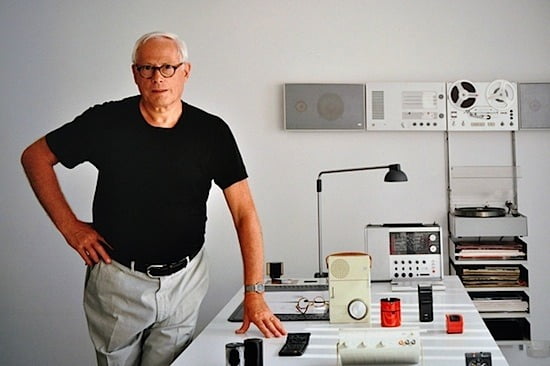
Dieter Rams
A simple and original approach to design
Designing and releasing products that were as free as possible from ornament and decoration, simple, easy to use and highly practical, the designer quickly achieved great fame, and his designs sold out. It is impossible not to admire the elegance of Rams’s designs. In products designed according to firm principles, never straying outside them, the influence of the Bauhaus and the Ulm School of Design is clearly visible. Dieter Rams continuously followed technology and, staying firmly away from imitation, blended technology with his originality to bring his products into being.
He designed his products with ease of use constantly in mind, creating practical objects that made life easier. Alongside this, he brought his singular aesthetic sense to these products, managing to touch the souls of the people who used them. He never exaggerated the promotion of his products, presenting customers exactly what they were, and in doing so quickly earned their trust. For Rams, the designer is less an artist than a mediator who arranges the relationship between the user and the product. That is why his products do not push themselves forward; they direct the user’s attention not to themselves but to the task at hand.
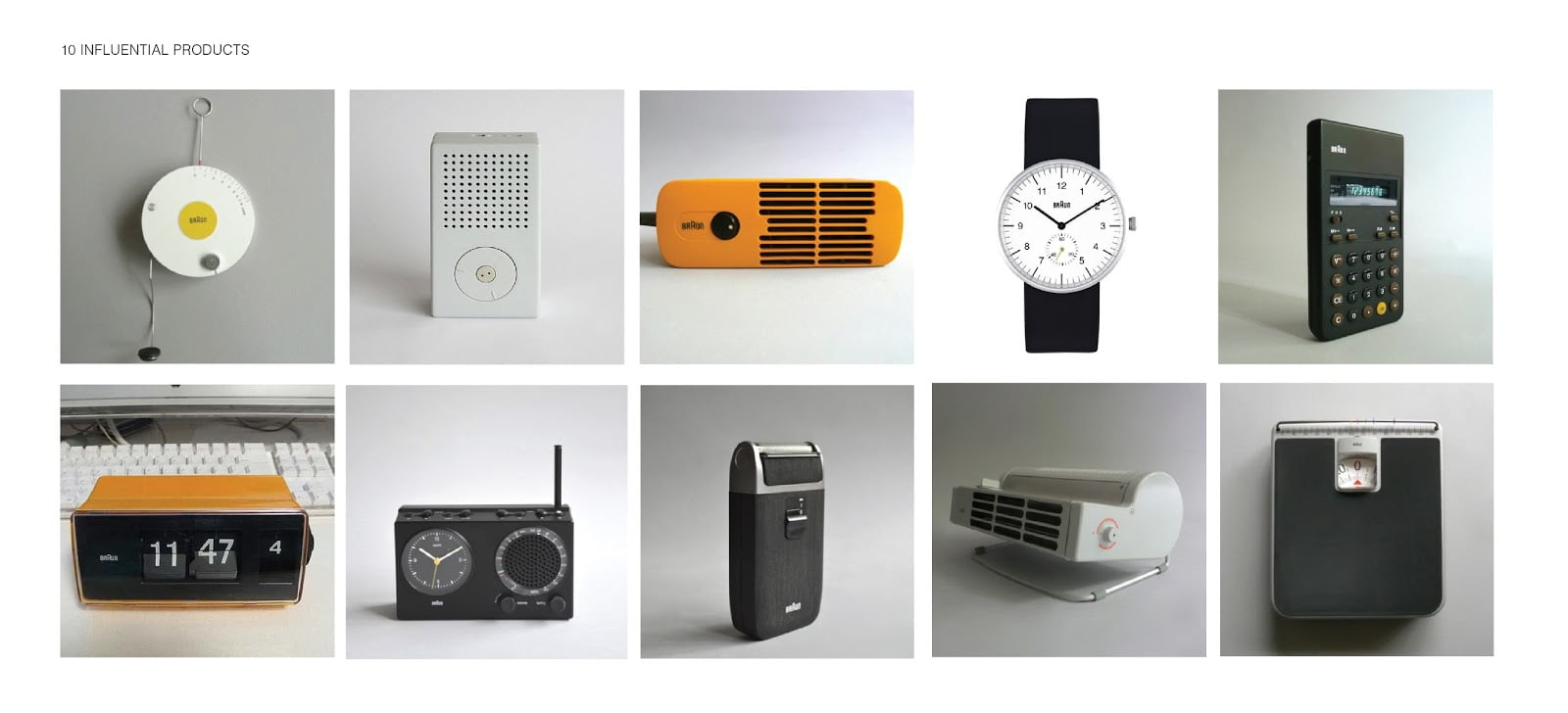
Dieter Rams, products
What did he design during his Braun years?
Rams’s true legacy lies in the product families produced under the Braun roof over the decades. The SK 4 record player, developed in 1956 together with engineer Hans Gugelot, was nicknamed Schneewittchensarg, or Snow White’s Coffin, because of its transparent acrylic lid, and it broke the established conventions of what music equipment could look like. The pocket-sized T3 radio is cited as a reference point that, decades later, inspired the screen layout of smartphone interfaces. Across widely different categories, including calculators, lighters, projectors, shavers and hi-fi systems, he managed to build a consistent, recurring visual language. Neutral colors, logically placed buttons and the absence of any unnecessary protrusion are the shared features of these devices.
Rams is also known in furniture for the 606 Universal Shelving System he designed for Vitsoe. This wall-mounted modular shelving system, which users can expand or shrink according to their needs and whose parts remain compatible even years later, is a concrete example of his understanding of longevity. The same thinking appears in the 620 chair program: the product is designed not to be fashionable but to last for decades and to be repairable.
What are the ten principles of good design?
In the 1970s, while questioning his own practice, Rams tried to define what good design is in a series of statements. The resulting ten principles are among the foundational texts of design education today. According to these principles, good design is innovative, makes a product useful, is aesthetic, makes a product understandable, is unobtrusive, is honest (meaning it does not promise anything the product cannot deliver), is thorough down to the last detail, is long-lasting, is environmentally friendly, and is as little design as possible. This last principle is summed up by the phrase Rams often repeated: Weniger, aber besser, that is, less but better. The “less” here is not deprivation but a fullness purged of the unnecessary.
Leaving his mark on the 20th century
With the philosophy that a well-designed product is untouched by fashion, he succeeded in creating long-lasting products, and with designs devoted solely to a product’s purpose, never letting anything else draw the user’s attention, he became a model for many designers. He put respect for his users first and stayed away from product designs that would offend the eye or create visual clutter. With all these rules and principles, he managed to leave his mark on the 20th century.
Rams’s influence did not remain confined to his own era. His neutral, simple, function-first language can be clearly traced in the electronic product thinking of the next generation of designers. Jonathan Ive, who long led design at Apple, has cited Rams as one of his greatest references, and the visual connection some products and interfaces make with the Braun classics has often been noted. For this reason, Dieter Rams is seen not as a master of the past but as a living source that also feeds the visual language of the digital age.
What can be learned from Dieter Rams today?
Rams’s approach carries a quiet critique of a consumer culture that constantly releases new models and quickly discards the old. His emphasis on longevity, repairability and avoiding the unnecessary aligns directly with today’s debates on sustainable design. Testing a product against the question of whether it is truly necessary, questioning whether every added part serves a function, and turning visual form into a tool for the user’s benefit are principles any designer can draw on, whatever their field. The real legacy Dieter Rams left is less the individual products than the way of looking at design itself.