
Born in the United Kingdom in 1834, Dresser ranks first among the most innovative and creative designers of his time. His university education was in botany. He became a professor of botany and published many books. He died in France in 1904. Using his deep botanical knowledge in his designs, he brought an entirely new aesthetic to objects such as fabrics and carpets. His patterns were used in many fields, from wallpapers to ceramics. Silver-plated wares hold an important place among his special designs. He was invited to design in the United States and Japan. Among the major brands he worked with was Tiffany.
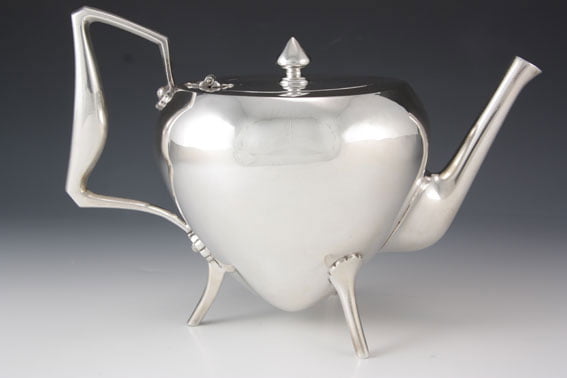
Christopher Dresser, Teapot
Why is he considered the first industrial designer?
Dresser represents an important turning point in design history. In his era, objects were either produced one by one in a craftsman’s workshop or reproduced in factories with no connection to design. Dresser inserted an entirely new role between these two: the independent professional who designs a product from the start with the production method in mind. He worked under contract with factories, licensed his designs to different manufacturers and put his own name on many of his works. This way of working was an early rehearsal of the profession we now call industrial design.
In his approach, form comes before ornament. How an object will be produced, how it will be held and what it will be used for directly determine how it looks. This is why Dresser’s works, departing from the heavily ornamented Victorian taste of his own era, look surprisingly contemporary. Many of his teapots and pitchers anticipate the modern design sensibility that would emerge fifty years after they were made.
Kitchenware and forms
Dresser produced highly successful work in several fields of design. The first of these is kitchenware. The objects he designed, usually silver-plated, have shapes that are marvels of geometry. His teapots are especially famous. While he did use rounded contours, he shaped many of his teapots in forms built of right angles. For the handles, too, he drew on rectangular rather than circular forms. His sugar bowl, napkin holder and pot designs are each more intriguing than the last. The other field in which he excelled was pattern.
In these metal objects Dresser honors the material rather than hiding it. The head of a bolt, a joint or the geometry of a handle is not concealed beneath ornament; on the contrary, it becomes a visible part of the design. Geometric bodies, exposed legs and clean lines give these objects an industrial honesty. The silver and silver-plated pieces Dresser designed for manufacturers such as James Dixon and Sons and Hukin and Heath are therefore regarded by collectors and museums as forerunners of modern design.

Christopher Dresser, Pattern
Patterns inspired by nature
His nature-inspired patterns are still used today on upholstery fabrics, carpets, ceramics and wallpapers. His background as a botanist played a large part in this. As a working principle, he would first draw the plants and measure them mathematically. In the wallpapers he designed with repeating motifs, the matchless proportions of nature can be seen. He also had a singular sense of color harmony, choosing the color of the motif above and the ground beneath so that they would complement and support one another.
What set Dresser’s approach to pattern apart was that instead of copying nature literally, he abstracted the order underlying it. When depicting a flower, he emphasized the plant’s symmetry, its branching logic and its direction of growth rather than rendering its leaves realistically. This method separates him from the naturalist decorative fashion of his period and brings him close to the approach to abstraction later seen in Art Nouveau and modern pattern design. He also set these principles down in the books he published, so his influence spread not only through the objects he made but through the method he taught.
In ceramic wares such as tea sets, vases and trays, he took care to reflect nature’s finest details and beauties. For the ground he used not only white but, as in nature, the harmony of blended colors. His admiration for nature was the greatest source of inspiration for his creativity.
The mark of Japanese aesthetics on Dresser
To understand Dresser’s mature work, one must look at the bond he formed with Japan. His long journey to Japan in 1876 made him one of the first Western designers to study this culture firsthand. The simplicity, balanced asymmetry and functional sense of form free of unnecessary ornament that he saw there worked their way deep into his output. The respect for material and the value of empty space in Japanese craft nourished the pure line of his metal and ceramic works. Through this exchange, Dresser became a rare designer who united the industrial possibilities of the West with the aesthetic discipline of the East.
In all these respects, Christopher Dresser was not merely an artist who produced beautiful objects but a pioneer who defined the designer’s role in the modern world. His botanical knowledge, industrial sensibility and international outlook carried him far beyond his own age.