
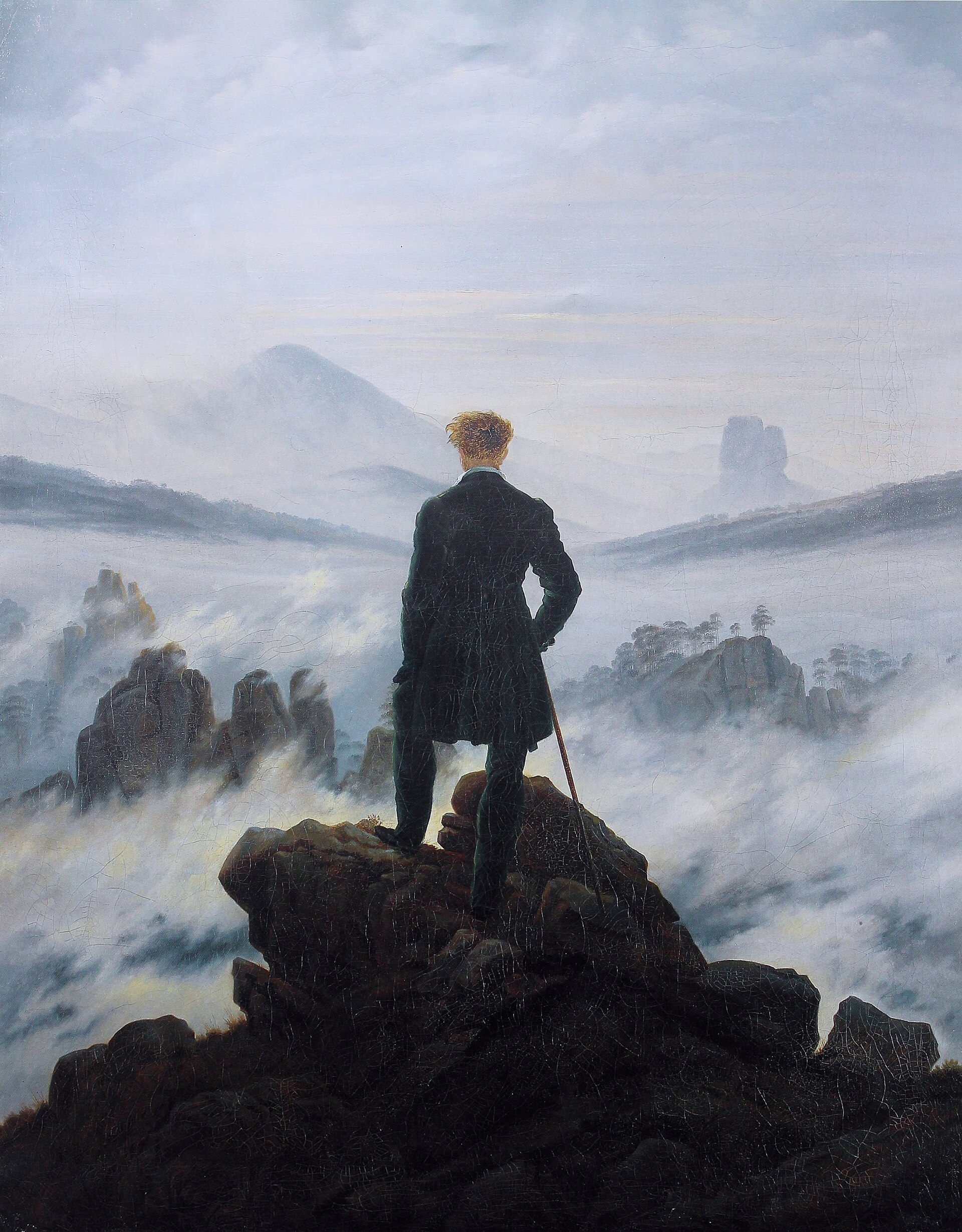
Caspar David Friedrich, Wanderer above the Sea of Fog, circa 1818.
Romanticism is an art movement that rose in Europe at the beginning of the 19th century, placing emotion, imagination, nature and individual experience at its center. The movement was born as a reaction to the rationalism and sense of order of the era that preceded it. For Romantic artists, a work’s value lies not in how closely it follows measured rules but in how powerful an emotion it stirs in the viewer. This approach redefined art’s task to a considerable degree and moved the individual’s inner world to center stage.
What is Romanticism and under what conditions was it born?
Romanticism is a broad cultural movement that took root in the late 18th century and matured in the first half of the 19th. It encompasses not only painting but also literature, music and thought. The fundamental idea behind the movement is that a person’s emotions, intuition and imagination are as valuable as their reason. This is why Romantic works foreground intensity over measured balance, movement over stillness, the extraordinary over the ordinary.
The period in which the movement was born was a time of great upheaval in Europe. The acceleration of the Industrial Revolution, the growth of cities and the shaking of the social order turned many artists toward nature, the past and the inner voice of the human being. Against the gaze of the age of reason, which measured and ordered everything, the Romantics defended the mysterious, immeasurable and emotional side of the world. Romanticism was, in a sense, an emotional answer to this rapid change. The artist was no longer an objective observer but a witness who projected their own feelings into the work.
What are the defining characteristics of Romanticism?
The most striking element in Romantic works is the way nature is treated. Nature here is not merely a backdrop but often a magnificent, terrifying force surpassing the human. Storms, boundless seas, misty mountains and ruins appear frequently. These images aim to make the viewer feel the smallness of the human and the greatness of nature. This feeling, called “the sublime” in art theory, describes an experience of greatness that arouses both awe and fear.
Another distinctive feature is that emotion is felt openly. Intense feelings such as fear, longing, loneliness, awe and rapture stand at the center of the work. Color and light are often used dramatically. The strong contrast of darkness and light adds tension to the scene and guides the viewer’s emotion.
Romanticism also glorifies the individual, the hero and the extraordinary. Interest in the past, especially the Middle Ages, national legends and a curiosity about distant lands are also frequent themes of this movement. What they all share is the search for an escape from the measured, orderly world of the age of reason. In this respect, Romanticism can also be read as a counter-pole defending emotion and freedom against the controlled order of Neoclassicism.
Who are the important Romantic artists and works?
Romanticism developed in different tones in different countries and found powerful representatives in each region. In Germany, Caspar David Friedrich strikingly conveyed the sublimity of nature by painting the human figure as a tiny point before boundless landscapes. Wanderer above the Sea of Fog, seen above, is one of the best-known examples of this approach.
In France, Eugène Delacroix represented the exuberant face of Romantic painting with his vivid colors and dynamic compositions. His painting Liberty Leading the People is an iconic example uniting emotion and action. Théodore Géricault produced powerful works carrying dramatic subjects onto large canvases, and with The Raft of the Medusa forcefully conveyed the human struggle between despair and survival. In England, J. M. W. Turner became known for sea and landscape paintings that carried light and atmosphere almost to the point of abstraction. William Blake revealed the movement’s imaginative side through his singular mystical world. In Spain, Francisco Goya gave one of the most powerful examples of the Romantic sensibility, reflecting the dark side of humanity and the horror of war with shattering sincerity.
How did Romanticism influence today’s design and later periods?
Romanticism’s influence reached far beyond its own era. Its stance foregrounding the artist’s personal emotion and individual outlook became a cornerstone for many later movements. The desire to observe nature directly and sincerely opened the way for the realist and impressionist tendencies that followed. The priority given to the expression of emotion can be seen as the beginning of a line extending in time to abstract and expressionist pursuits.
From a design perspective, Romanticism showed that form can be judged not only by its function but also by the emotion it stirs. The power of a space, an object or an image to create atmosphere and feeling in a person is a subject designers still dwell on today. In contemporary brand experiences, emotional design, campaigns built on storytelling and visual languages that create atmosphere carry the direct traces of this Romantic legacy. Drawing inspiration from nature, using dramatic light and narrative-driven approaches live on across a broad field, from cinema and game design to interior architecture.
In interior architecture, the prominence of natural materials, organic forms and a space’s power to stir feeling is a contemporary reflection of the Romantic sensibility. In graphic design, approaches that aim to produce emotion and experience rather than merely convey information draw on this legacy. In this respect, Romanticism is an important turning point that strengthened the bond between art and emotion and prepared the ground for the development of modern design thinking.