
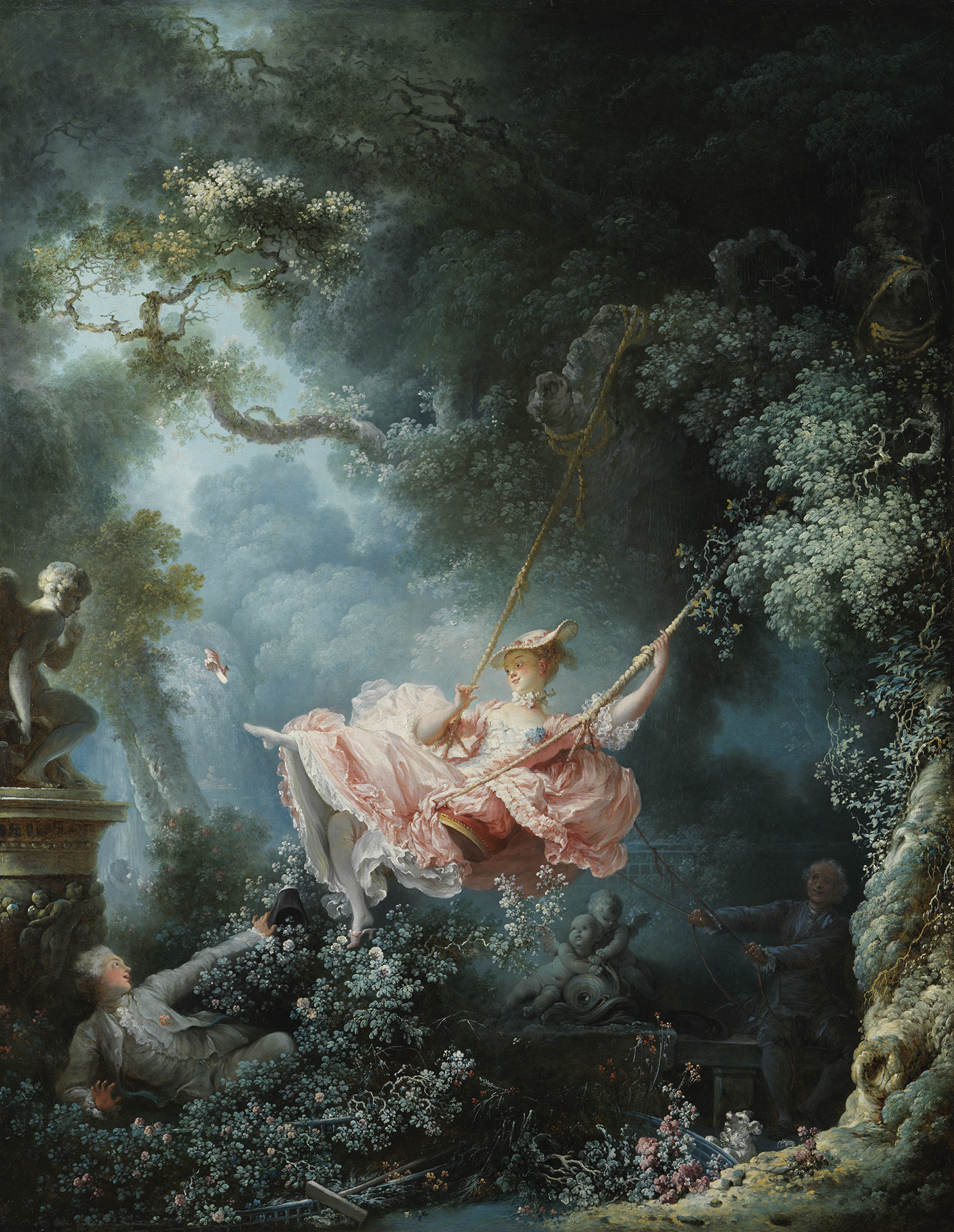
Jean-Honoré Fragonard, The Swing, 1767.
Rococo is an art movement that emerged in 18th-century France, foregrounding lightness, elegance, playfulness and dense ornamentation. Its name is associated with the French word “rocaille”, which describes the curling decoration used in stone and shell work. Born both as a reaction to the grand, solemn Baroque of the previous era and as a softened continuation of it, Rococo brought the daily life of the court and the nobility, love, entertainment and the refined pleasures of private life to the center of art. In this respect, Rococo is a movement that celebrates small, intimate and delightful moments rather than grand historical narratives.
What is Rococo and how did it emerge
Rococo began to develop in the first half of the 18th century, in the noble townhouses of Paris after the end of the reign of Louis XIV. Moving away from the formal, imposing atmosphere of Versailles, the aristocracy wanted more intimate, more comfortable and more pleasurable interiors. As court society moved to the capital, to bourgeois residences and smaller salons, art too had to adapt to this new way of living. This desire was reflected directly in art.
Rococo is not merely a painting style but a comprehensive outlook on taste that encompasses interior design, furniture, porcelain, textiles and architectural ornament. The walls, ceiling, mirrors, furniture and even the small decorative objects of a room were conceived as a single harmonious composition. In this respect, Rococo can be counted among the early and powerful examples of art and design interweaving. The idea of designing a space holistically today draws its roots largely from this outlook.
Lightness lies in the movement’s spirit. Heavy narratives, dramatic shadows and grand religious or historical scenes give way to everyday happiness, flirtation and peaceful moments in nature. The subjects mostly avoid seriousness, offering the viewer a smile, a stolen glance.
What are the defining characteristics of Rococo art
Rococo works have a visual language recognizable at first sight. Their most distinctive characteristics can be listed as follows:
- A light, soft color palette: pastel pinks, pale blues, cream tones and gold accents are used frequently.
- Curving, asymmetrical and flowing lines: shell, leaf and branch motifs taken from nature form the basis of the ornamentation.
- Light and playful subjects: love, seduction, music, play and scenes set in nature.
- Dense but elegant ornamentation: surfaces are rarely left empty, yet this fullness feels cheerful rather than overwhelming.
- Soft light and delicate brushstrokes: figures are generally painted as slender, graceful and idealized.
Fragonard’s The Swing, at the top of this page, captures the movement’s mood very well. The young woman on the swing, her flying shoe, her hidden admirer and the light-bathed green garden sum up Rococo’s playful, weightless world. Rather than delivering a serious message, the scene celebrates the grace and mischievous joy within a single moment. The sharp light contrast of the Baroque here gives way to a soft, silvery brightness spreading in every direction.
Who are the important Rococo artists and works
Rococo matured in the hands of a few powerful figures. Jean-Antoine Watteau is regarded as the movement’s pioneer. He is known for elegant scenes of nobles at leisure in nature, and works such as The Embarkation for Cythera are touched by a light melancholy. The fête galante he developed, the scene of refined outdoor amusement, became a genre unique to the period.
François Boucher became one of the most favored figures of the era with his bright colors, mythological subjects and decorative elegance. Thanks to his close relations with the court and patrons such as Madame de Pompadour, he came to be seen as the official face of Rococo taste. Jean-Honoré Fragonard stands out as the movement’s most lively and playful interpreter. His work The Swing is one of the best-known emblems of the Rococo spirit.
Alongside these three French masters, the movement also left its mark in other lands. In Italy, Giambattista Tiepolo gave Rococo a broad, airy scale with his bright colors and magnificent ceiling paintings. In sculpture and porcelain, the period’s graceful, curving language matured in centers such as the Meissen workshops in Germany. What these artists shared was that they directed their technical mastery toward light, pleasurable themes rather than solemn subjects.
How did Rococo influence today’s design and later periods
Rococo’s most lasting influence is perhaps seen in the field of design. The curving, asymmetrical language developed in furniture, mirrors, wall ornament and porcelain shaped the decorative arts of Europe for a long time. The idea of treating the interior as a unified composition left an important legacy to the design thinking of later periods. The approach of constructing a setting as a single harmonious experience through color, texture, furniture and lighting is also among the fundamental principles of today’s interior architecture.
Rococo’s organic, curving motifs taken from nature came back to life at the end of the 19th century in the Art Nouveau movement. Botanical forms, flowing lines and asymmetrical order spread across that era’s posters, furniture, jewelry and architectural detail. In this respect, Rococo can be counted among the roots of the organic design language. The pastel palettes, gold accents and graceful ornamentation seen in contemporary packaging, invitation and luxury brand design are contemporary echoes of the same sensibility.
At the same time, Rococo was criticized as overly ornate and superficial. Toward the end of the century, the Neoclassicism movement, championing simplicity, seriousness and moral values, rose as a direct reaction to Rococo’s lightness. Straight lines, calm order and ancient themes began to replace the curling ornament. Yet in every era when decorative elegance regained value, the traces of Rococo reappeared. Today Rococo is remembered as an impressive period that shows how art and design can interweave, defending lightness and elegance as values in their own right.