
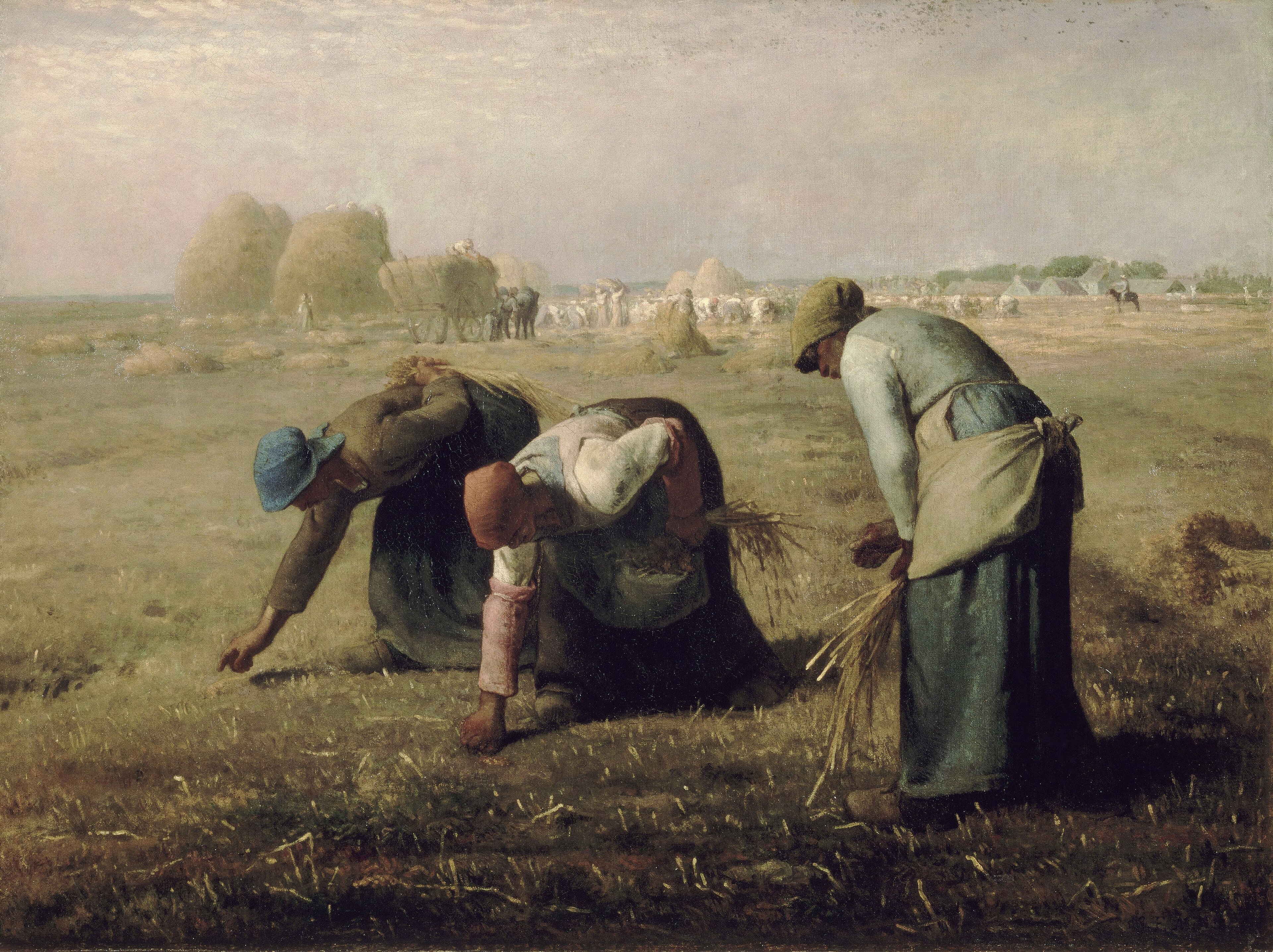
Jean-François Millet, The Gleaners, 1857.
Realism is an art movement that emerged in mid 19th-century France, aiming to paint everyday life and ordinary people without exaggeration, as they are. The movement developed as a reaction to the exalted, idealized expression of the period that preceded it. For Realist artists, the subject of art was to be sought not in distant legends or magnificent scenes but in the very world one lives in. This approach fundamentally changed whom and what art looks at.
What is Realism and how did it emerge?
Realism is the effort to render the reality the artist observes without embellishing or magnifying it. In this movement, peasants working the fields, laborers, city streets and ordinary daily moments are seen as subjects worthy of painting in their own right. These groups, which in earlier periods had mostly remained in the background or been ignored altogether, moved to the leading role in the works of Realist artists. The movement’s name comes from the principle that the artist should paint only what they have actually seen.
The years in which the movement was born were a period of accelerating industrialization and social change in Europe. The social awareness that followed the revolutions of 1848 turned artists toward the life and labor of ordinary people. The growth of cities, the new visibility of labor and the sharpening of social inequalities made artists look at the concrete reality around them. In this sense, Realism was not just a formal search but also a way of looking at society and labor. Rather than imagining a world they had not seen, the artist preferred to record what they had actually seen.
What are the defining characteristics of Realism?
The most distinctive feature of Realist works is that their subjects are chosen from daily life. Mythological heroes and historic victories give way to women gleaning in the fields, laborers breaking stones and ordinary small-town scenes. This choice offers a new answer to the question of whom art represents.
Another important characteristic is an expression based on observation and free of exaggeration. Colors are generally plainer and earthier in tone, and light is used for credibility rather than dramatic effect. Figures are not idealized; the fatigue, posture and labor of real people are reflected as they are. The details of the scene, with spaces and objects rendered faithfully, form a convincing whole.
Realism also values an honest gaze. The artist does not beautify the scene to impress the viewer; on the contrary, they do not shy away from showing the ordinary and sometimes harsh sides of life. This sincerity is one of the movement’s most distinguishing traits and clearly separates it from the earlier outlook that foregrounded emotional intensity. Realism thus takes art out of the role of an escape and turns it into a mirror of the society one lives in.
Who are the important Realist artists and works?
Realism’s strongest representatives came of age in France. Gustave Courbet is regarded as the pioneer of the movement. By bringing ordinary people onto large-scale canvases, he applied a scale until then reserved for grand subjects to everyday life, a stance that provoked significant controversy in his time. His works The Stone Breakers and A Burial at Ornans are examples that paint ordinary labor and village life with monumental gravity.
Jean-François Millet became known for works depicting peasant life and agricultural labor in a plain, respectful language. The Gleaners, seen above, made the dignity of labor visible by painting, in a calm but striking manner, the women gathering the grains left in the field after the harvest. His work The Sower carries the same sensitivity. Honoré Daumier represented the movement’s critical side with works observing the ordinary city dweller and social life. His work The Third-Class Carriage sincerely reflects the tired, ordinary face of urban life. Jean-Baptiste-Camille Corot contributed to this line with works that connect nature and everyday life through plain observation.
What is the difference between Realism and Romanticism?
Realism can be read as a reaction to the Romanticism that immediately preceded it. While Romanticism glorifies emotion, imagination, the hero and the extraordinary, Realism foregrounds the ordinary, observable reality and everyday labor. In the Romantic work dramatic light and fervor dominate, while in the Realist work plain light and calm observation prevail. The Romantic artist turns to distant lands and the past, while the Realist artist looks into their own age and surroundings. This opposition marks an important turning point, showing art’s oscillation between imagination and reality.
How did Realism influence today’s design and later periods?
Realism’s influence proved decisive for the subsequent development of art. The importance placed on observation and real life soon opened the way for the Impressionist pursuits that tried to capture light and the moment. The recognition of ordinary subjects as valuable was a lasting gain that broadened the range of subjects in modern art. With the rise of photography, the idea of documenting reality settled at the center of visual culture.
For design, Realism reminds us of the importance of form’s connection to reality. Carefully observing the world one lives in, understanding users’ real needs and everyday lives, is one of the cornerstones of design thinking today. In contemporary design, user research, field observation and the effort to understand real context can be considered a direct extension of the Realist stance. The Realist outlook that puts function and honesty before ornament also aligns with the later design approaches that champion simplicity and functionality.
In graphic and product design, honest use of materials, unexaggerated expression and solutions grounded in real experience are the contemporary reflections of this legacy. Designing a product by observing its real conditions of use, or constructing an image faithfully to reality, is today’s counterpart to the culture of observation Realism left behind. In this respect, Realism can be regarded as an important movement that brought art closer to everyday life and prepared the ground for a design culture based on observation.