
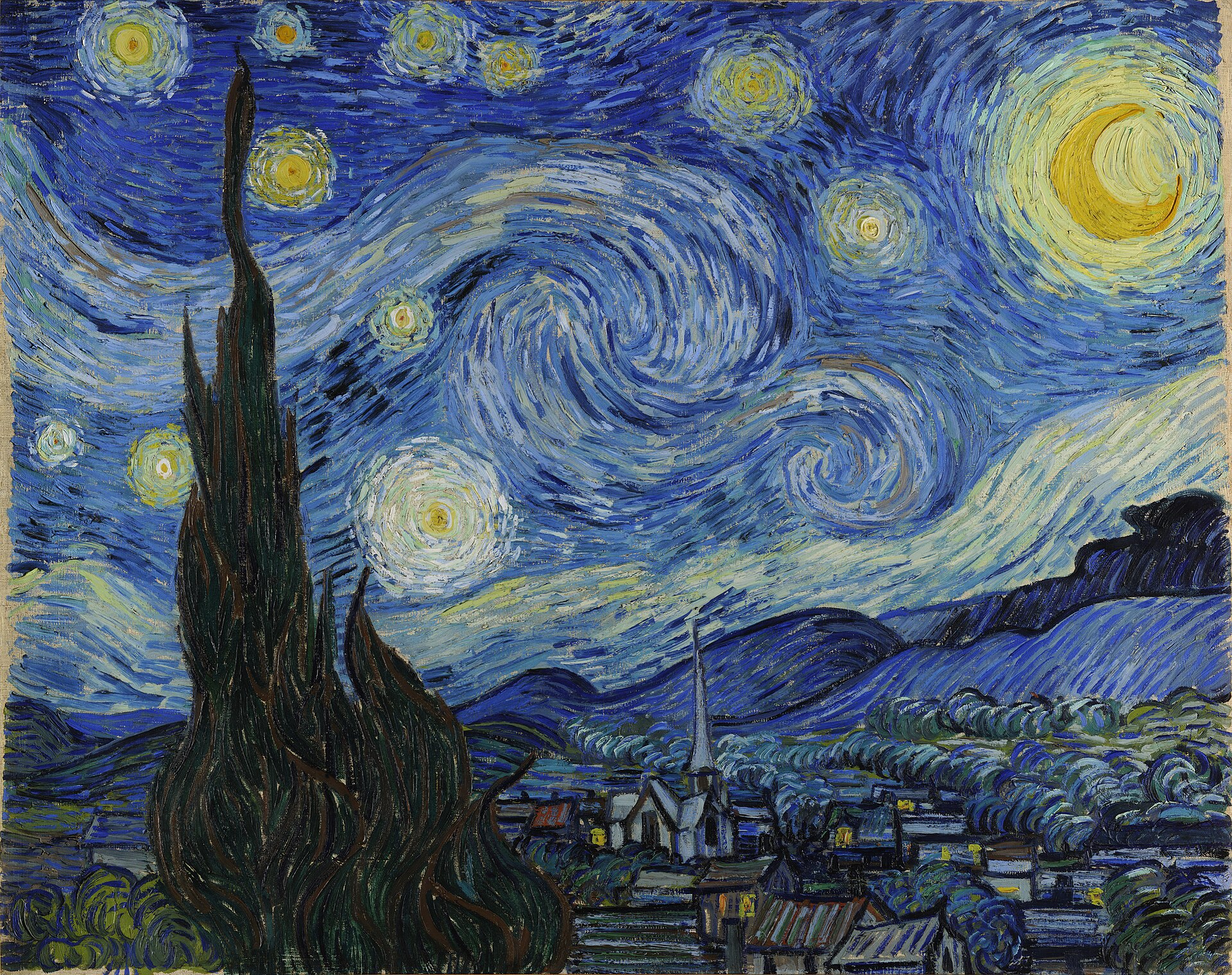
Vincent van Gogh, The Starry Night, 1889.
Post-Impressionism is a painting movement that developed in France in the late 19th century, after Impressionism, combining its discoveries in light and color with a search for personal emotion, form and structure. This movement cannot be defined by a single shared style. On the contrary, it encompasses a broad field of expression formed by artists who set out from Impressionism and branched off in very different directions. The common thread is the effort to go beyond the fleeting impression and give painting deeper meaning and permanence. The term came into use later, to gather these artists under a common heading.
How was Post-Impressionism born?
Post-Impressionism was born of the search of artists who found Impressionism’s goal of capturing only what the eye sees insufficient. The Impressionists had masterfully painted the momentary effect of light, but to some artists this approach seemed too superficial and fleeting. The Post-Impressionists wanted not to render what they saw as it was, but to add their own emotions, thoughts and sense of form to what they saw. For them, painting was less a faithful mirror of nature than an interpretation passing through the artist’s mind.
For this reason, the movement is the name of a period and an attitude more than of a style. Some artists loaded color with symbolic meaning, some sought the geometric structure underlying objects, and some developed new techniques based on scientific color theories. What they all shared was that they took painting beyond being a mere instrument of observation and made it a carrier of thought and feeling. This diversity makes the movement a rich transitional period that fits no single definition.
What are the defining characteristics of Post-Impressionism?
In Post-Impressionism, color gains an expressive power independent of reality. The artists could paint the sky bluer than it was, a field yellower than it was, because what mattered was no longer the object’s true color but the emotion the artist invested in it. Brushstrokes are often strong, visible and rhythmic. The paint itself, with its texture and movement, becomes part of the expression.
The movement’s distinctive qualities can be summarized as follows:
- The use of color as an emotional and symbolic instrument
- A more deliberate, structural construction of form and composition
- Visible, expressive and often thick brushstrokes
- The search for a lasting order beyond the fleeting impression
- The projection of the artist’s inner world into the painting
These characteristics moved painting away from being a copy of nature and made it a field for the artist’s subjective interpretation. As each artist built their own visual language, they all moved around a common goal: the deepening of expression. Painting thus ceased to be an image recorded by the eye and became a world constructed by the mind and the emotions.
Important artists and works
The best-known figure of the movement is Vincent van Gogh. With his intense colors and swirling, curling brushstrokes, van Gogh carried the turbulence of his inner world onto the canvas. His transformation of the sky into a living, moving presence in “The Starry Night” is one of the most striking examples of this emotional expression. His Sunflowers series and self-portraits also show the intense emotion he invested in color.
Paul Cézanne brought a new structural order to painting by investigating the basic geometric forms underlying objects. By painting Mont Sainte-Victoire over and over, he turned a landscape into a field of structural research. This search of his is considered one of the most important factors preparing the ground for the birth of Cubism in the years that followed. Paul Gauguin, with his flat areas of color and symbolic expression, painted distant lands and inner worlds; the works he made in Tahiti are the peak of this search.
Georges Seurat brought a scientific rigor to painting with pointillism, a technique that builds an image by placing small dots of color side by side. A Sunday Afternoon on the Island of La Grande Jatte is the best-known example of this method. Henri de Toulouse-Lautrec painted Parisian nightlife in striking compositions and posters, making an original contribution to both painting and graphic art.
Although these artists followed entirely different paths, they all took the legacy of Impressionism and transformed it through their own singular visions.
How did Post-Impressionism influence modern art?
Post-Impressionism is regarded as the direct forerunner of modern art. The liberation of color from reality, the abstraction of form and the placing of the artist’s subjectivity at the center are the most important breaks that opened the way to 20th-century art. Cézanne’s structural search inspired Cubism, while the emotional use of color by van Gogh and Gauguin inspired movements such as Expressionism and Fauvism. Artists such as Picasso and Matisse advanced along the path these pioneers opened, expanding the boundaries of abstraction.
The movement’s real importance lies in proving that art no longer had to reflect reality. Once color and form became means of expression independent of reality, nothing stood in the way of painting becoming fully abstract. In this sense, Post-Impressionism is the bridge between classical painting and modern art.
Influence on later periods and today’s design
For design, the importance of this legacy is great. The idea that color can be used not only to depict but to create emotion and meaning lies at the foundation of today’s visual communication. In a brand’s identity, in the atmosphere of a poster or in the color choices of a digital interface, we look to emotional impact more than realism. This approach is closely akin to the freedom the Post-Impressionists granted to color.
Toulouse-Lautrec’s lithographic posters are counted among the direct ancestors of modern graphic design and the advertising image. His approach of uniting plain areas of color, strong contour and typography with the image is still alive today in poster and packaging design. Gauguin’s flat color areas, in turn, align with the plain, flat approach to color in illustration and digital interface design.
Likewise, the approach of constructing composition as a deliberate structure is one of the fundamental principles of design. Cézanne’s effort to reduce objects to geometric foundations is kin to the structural thinking of product design and grid-based interface layouts. The Post-Impressionists’ effort to go beyond the visible and produce meaning aligns directly with the contemporary designer’s responsibility to carry a message and an emotion in every image. This movement thus becomes, alongside a turning point in art history, one of the roots of modern design thinking.