
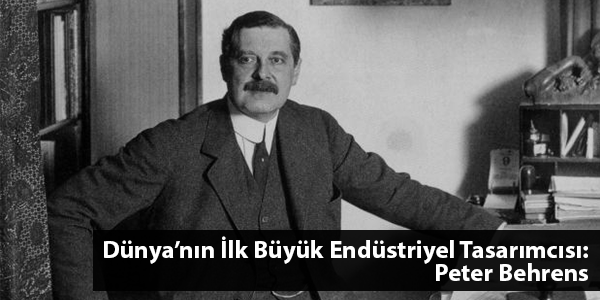
Renaissance man, design expert
Peter Behrens, born on 14 April 1868 in Hamburg, Germany, is known as the first great industrial designer in world history and the figure most identified with corporate identity. Believing that design played a major role in the development of industry, Behrens made his name with the work he did for AEG in 1907. His career, which began with training in painting, expanded over time from painting to graphics, from graphics to product design and architecture. This versatility is also the fundamental reason he was able to unite different fields under the same design philosophy.

Behrens, who worked in graphic design and architecture as well as industrial design, is considered the first person to prepare and carry out a corporate identity design program.
What did he do for AEG?
The turning point for Behrens was the relationship he established in 1907 with AEG, the great electricity company of the era. When he took up his post as the company’s artistic advisor, he was expected to organize not a single poster or a single product, but the company’s entire visible face. Behrens designed the lamps, fans, water heaters and kettles; in doing so, he made sure the parts were mutually compatible, producible and standardizable. At the same time he tied the company’s emblem, its typeface, its posters, catalogs and brochures to a single visual language. In this way he brought to life the idea that the objects a company produces and the story it tells could be parts of the same whole. This approach is considered the birth of the discipline we today call corporate identity.
The philosophical attitude that emerged in the 19th century was given the name New Objectivity. The influence of this attitude can be seen in Behrens’s industrial designs for AEG, such as stoves, clocks and kettles; forms stripped of ornament, openly displaying their function and suited to mass production were his fundamental pursuit.
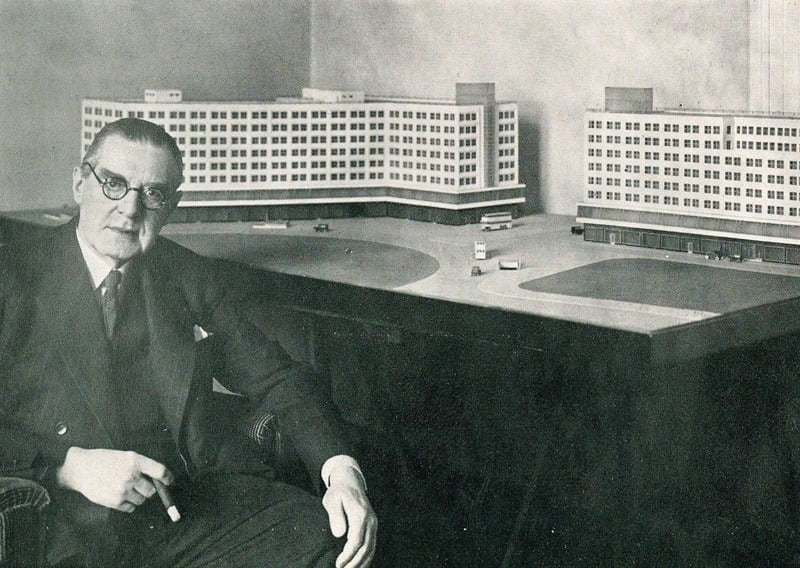
Why is the AEG Turbine Factory important?
Behrens’s best-known work in architecture is the AEG Turbine Factory, which he designed in Berlin in 1909. With its broad surfaces of glass and steel, this building showed that an industrial structure could go beyond being a merely functional shell and become a symbolic monument of its era. The factory proved that industrial architecture was now a field of design to be taken seriously, and it came to be regarded as one of the cornerstones of modern architectural history. Here Behrens masterfully combined the gravitas of classical architecture with the materials of the machine age.
He created designs all his own
Behrens’s work in graphic design covers emblems, brochures, catalogs, press advertisements, posters, packaging, stationery and typography. In the work for AEG, for example, he used the emblem he had prepared together with the typeface and various layouts, achieving unity in the visual identity. In his approach, form and text, product and advertisement are not disconnected pieces but different manifestations of the same idea.
Professor Peter Behrens is also described as a Renaissance man. Considering that every new product design proceeds from a foundation of knowledge and experience reaching far back in time, Behrens’s work drew attention for its originality.
How did he train the masters of modern architecture?
Another factor that magnifies Behrens’s place in design history is the names that passed through his Berlin office. Three great figures who shaped 20th century architecture, Walter Gropius, Ludwig Mies van der Rohe and Le Corbusier, each worked in his studio for a time. Gropius later founded the Bauhaus and redefined modern design education, Mies van der Rohe became known for his “less is more” philosophy, and Le Corbusier became one of the most influential theorists of modern architecture. This is why Behrens is remembered not only for his own works but also as a teacher who trained the founding generation of modernism.
The development of corporate identity and the present-day form of functional objects lie hidden in Behrens’s creativity. Because of his role in the development of industrial design, and because he was the first person to carry out that design as a holistic program, Behrens has gone down in the record as the spiritual father of corporate identity.
Peter Behrens died on 27 February 1940.