
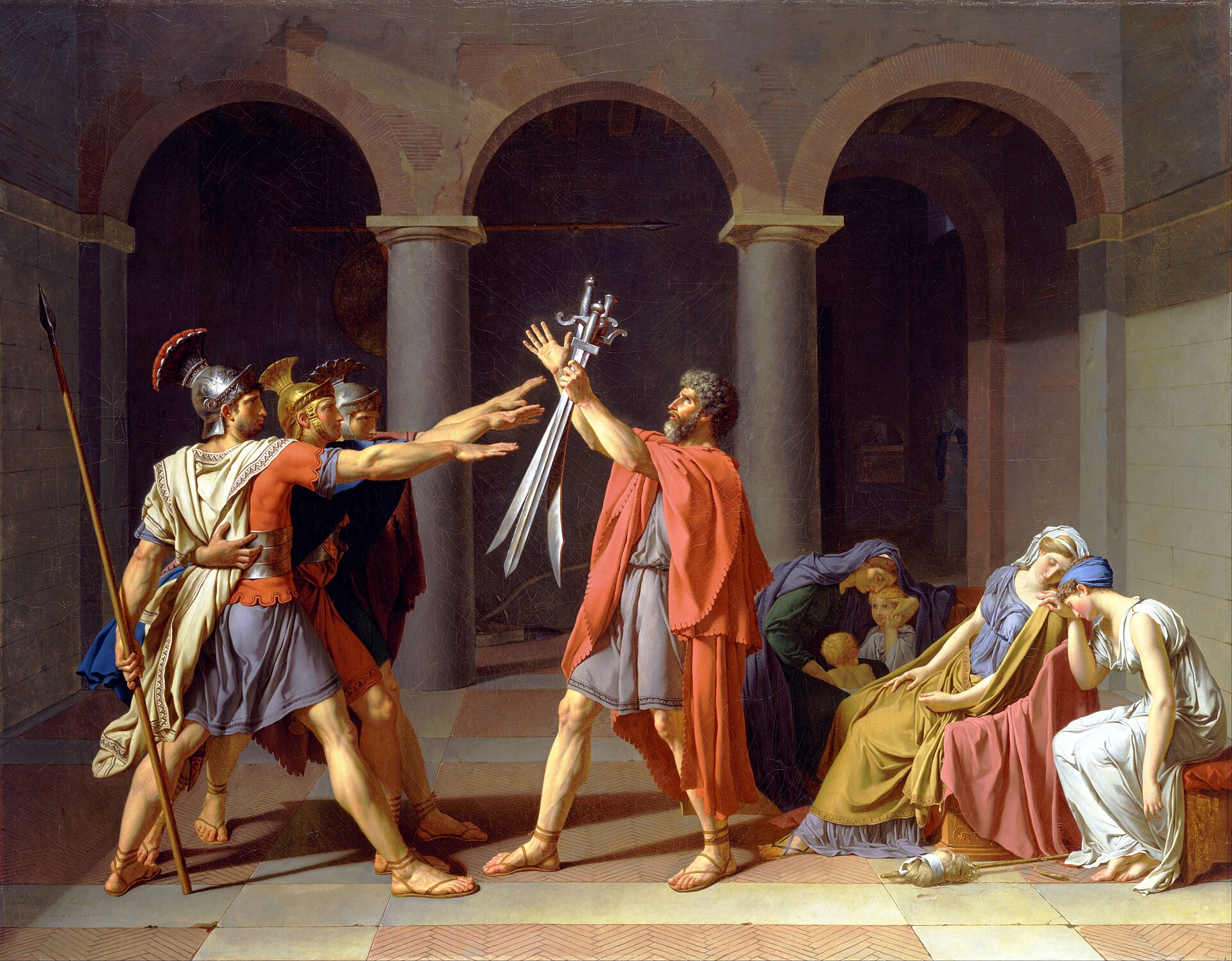
Jacques-Louis David, Oath of the Horatii, 1784.
Neoclassicism is an art movement that developed in Europe in the late 18th and early 19th centuries, drawing inspiration from ancient Greek and Roman art to emphasize simplicity, balance and moral seriousness. Meaning “new classicism”, the movement was born as a distinct reaction to the lightness and excessive ornamentation of the Rococo that preceded it. Taking the noble simplicity and heroic virtues of the ancient world as their model, the artists aimed to restore gravity and order to art.
What is Neoclassicism and how did it emerge?
Neoclassicism emerged in a period when Enlightenment thought was spreading across Europe. In this age, when concepts such as reason, virtue, duty and discipline gained value, artists too sought a visual language that would reflect these values. In the same period, the excavations that brought ancient cities such as Pompeii and Herculaneum back to light, along with growing interest in classical architecture, markedly strengthened the turn toward ancient Greek and Roman art. The art historian Johann Joachim Winckelmann’s description of ancient art as “noble simplicity and quiet grandeur” prepared the intellectual ground for this orientation.
In this movement, art carries a purpose beyond merely producing beauty. The works often deliver a moral lesson, glorifying heroism, sacrifice, love of country and devotion to duty. In this respect, Neoclassicism is closely related to the social and political atmosphere of its era. The great transformations before and after the French Revolution aligned this art of heroism and civic virtue directly with the spirit of its time. David’s Oath of the Horatii, at the top of this page, clearly shows this spirit. The resolute, balanced and plain composition formed by the three brothers reaching for their swords and the father who commands them conveys the tension between duty and feeling with striking gravity.
What are the defining characteristics of Neoclassicism?
Neoclassical works have a clear visual outlook that stands in direct opposition to Rococo. Their principal characteristics can be summarized as follows:
- Plain and balanced composition: figures are placed in an orderly manner, avoiding unnecessary ornamentation.
- Clear and sharp lines: form and contour are prominent enough to take precedence over color.
- Ancient subjects: Greek and Roman history, mythology and heroes are frequently treated.
- Restrained use of color: colors generally support the clarity of the narrative rather than dramatic effect.
- Sculptural figures: the human body is painted in an idealized, solid manner, as in ancient statues.
- Moral and serious themes: duty, virtue, sacrifice and heroism come to the fore.
These characteristics also found a strong counterpart in architecture. Columns, pediments, symmetrical facades and classical proportions were widely used in the buildings of the period. In painting, rendering the brushstroke almost invisible, the smoothness of the surface and the construction of the composition within an architectural order reinforce the movement’s disciplined character. Light is generally used to read the figures clearly, while shadows define volume.
Who are the important Neoclassical artists and works?
The most powerful figure of Neoclassicism is Jacques-Louis David, who became virtually the movement’s spokesman in painting. His paintings such as Oath of the Horatii and The Death of Socrates are among the best-known examples uniting ancient subjects with the era’s understanding of virtue. His student Jean-Auguste-Dominique Ingres carried the movement to the next generation with his flawless line and elegant portraits. His work La Grande Odalisque shows how decisive form and line were in the Neoclassical outlook.
In sculpture, Antonio Canova became one of the most important figures of the period with his smooth, balanced marble works approaching the ancient ideals. Works such as Psyche Revived by Cupid’s Kiss are masterful examples in which marble takes on a sense of softness and movement. The Danish sculptor Bertel Thorvaldsen continued this line with serene works on ancient mythology. In the German-speaking lands, artists such as Angelika Kauffmann contributed to the spread of the Neoclassical outlook. In architecture, designers such as Robert Adam carried the classical order into interiors and facades, embedding the movement in building culture. The common goal of these artists was to carry the noble simplicity of the ancient world into their own age.
What is the difference between Neoclassicism and Romanticism?
Neoclassicism and the Romanticism that immediately followed it represent two outlooks that can be read as opposites. Neoclassicism champions reason, order, symmetry and a measured expression in which emotion is kept under control. Romanticism foregrounds emotion, individuality, imagination and the uncontrollable power of nature. In the Neoclassical work line and form dominate, while in the Romantic work color, movement and atmosphere come forward. This opposition marks an important turning point in art history, showing the shifting weight of reason and emotion. Yet the two movements do not entirely exclude each other, because the disciplined foundation of Neoclassicism also prepared the structure on which Romantic fervor would rise.
How did Neoclassicism influence today’s design and later periods?
The influence of Neoclassicism was not confined to painting and sculpture; it also spread to architecture, furniture and the decorative arts. Symmetry, clear proportions and classical motifs became decisive in the building and object design of the period. This plain, orderly outlook continued to be favored for public buildings, monuments, museums and official structures in later periods. The columned, symmetrical facades seen today on many government buildings carry the traces of this legacy.
From the perspective of graphic design, Neoclassicism’s hierarchical order, balanced use of space and restrained ornamentation still appear in corporate identities and official document design. Many brands choose classical proportions and symmetrical arrangements to convey a sense of trust and heritage. In interior architecture, the pursuit of balance, proportion and plain elegance is a direct extension of the Neoclassical legacy. In product design, the idea of stripping form of unnecessary ornament also overlaps with the fundamental principles of modern minimalism.
In terms of art history, Neoclassicism is also important as a point of transition and balance. Its stance foregrounding order and reason soon prepared the ground for the birth of Romanticism, which emphasized emotion, individuality and fervor. From a design perspective, Neoclassicism is remembered as a lasting example showing that simplicity and proportion can be powerful aesthetic values in their own right.