
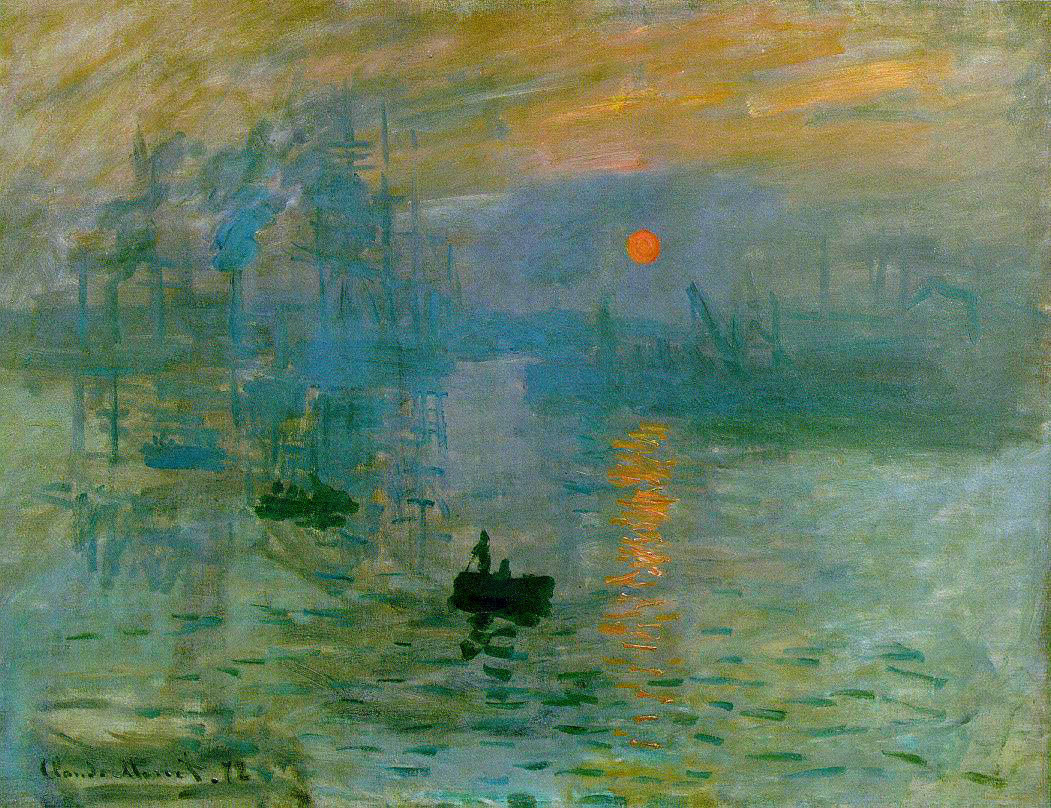
Claude Monet, Impression, Sunrise, 1872.
Impressionism is a painting movement that emerged in France in the last quarter of the 19th century, aiming to transfer the momentary effect of light and atmosphere directly onto the canvas. The movement takes its name, partly through a mocking review, from Claude Monet’s painting “Impression, Sunrise”. Instead of meticulously drawing the precise contours and detailed surfaces of objects, Impressionist painters emphasized the impression of color and light that the eye perceives in a given moment. This approach created a radical break that shifted painting’s purpose from depiction to perception.
How did Impressionism emerge?
Impressionism was born as a reaction to the rigid rules of traditional academic painting. Until then, painting had largely treated historical, religious or mythological subjects with a smooth technique labored over at length in the studio. Official exhibitions and academies imposed strict criteria on what counted as art. The Impressionists left the studio and went out into nature, into the open air. This method of painting outdoors, known by its French name “plein air”, became the cornerstone of the movement.
Behind this transformation lay a technological development as well. The production of ready-made paint in tubes made it possible for artists to carry their paints with them and work in nature. Artists painted the changing light at different hours of the day, the color transitions of the seasons and the vibration of the air through direct observation. This is why the subject in Impressionist paintings often feels like a pretext. The real question is how that subject looks at a particular moment, how light strikes surfaces and what colors the shadows take on. This perspective inaugurated a new era in art history in which perception and subjectivity came to the fore.
What are the defining characteristics of Impressionism?
The most distinctive feature of Impressionism is its short, rapid brushstrokes. Colors are placed side by side on the canvas and merge in the viewer’s eye when seen from a distance. This technique gives the painting a lively, vibrating appearance. The artists avoided using black in shadows, preferring instead to express them in blues, purples and other vivid tones. For them, even shadow was not a colorless darkness but another state of light.
The movement’s other notable qualities can be summarized as follows:
- Capturing the fleeting effect of light and the moment
- Painting outdoors, from direct observation
- Deliberately softening sharp contours and fine detail
- Ordinary subjects drawn from daily life, the city and nature
- The side-by-side use of bright, unmixed colors
The Impressionists painted cafés, railway stations, riverbanks, gardens and crowded city streets. For these artists, the fleeting sights of modern urban life were far more valuable than tales of heroism. Art thus left the monopoly of noble subjects and moved into everyday life. The dispersal of steam in a train station or a sunny afternoon in a park was considered as worthy a subject as a historic battle scene.
Important artists and works
The best-known name of the movement is Claude Monet, the source of its name. Monet investigated the changing effect of light by painting the same subject over and over at different hours of the day and under different lighting conditions. His series on water lilies, haystacks and the facades of Rouen Cathedral are products of this meticulous observation. The water lily paintings he made in his garden at Giverny reach the threshold of abstraction in the final period of his life.
Pierre-Auguste Renoir is known for treating the human figure and social life in warm, luminous colors. In works such as Dance at Le Moulin de la Galette, he paints the play of sunlight over figures within a lively crowd. Edgar Degas painted ballet dancers and figures in motion in striking compositions. In works such as The Dance Class, he captures the ordinary moments backstage from unusual angles.
Camille Pissarro, who treated both rural landscapes and city views, was one of the pioneers who steered the movement and became a mentor to younger artists. Berthe Morisot played an important role in the movement’s development, painting female figures and domestic scenes with refined sensitivity. Alfred Sisley devoted nearly his entire career to landscape, masterfully capturing atmosphere in his river and sky scenes.
Because they were excluded from the official exhibitions of the period, these painters organized their own shows. These independent exhibitions were an important step in showing that artists could chart their own course without depending on institutional authority.
How did Impressionism change art history?
Impressionism did not remain merely a painting movement; it created a fundamental break in how art and design were understood. This approach, which foregrounded the subjectivity of perception and the value of the moment, gave courage to the generations that followed. The Post-Impressionists who came immediately after adopted Impressionism’s discoveries in light and color and carried them into a more personal, structural mode of expression. The idea of painting not “what one sees but how one perceives what one sees” became a seed that influenced the whole of modern art.
This new interest in color and light opened the door to modern art. On the road to abstraction, the expression of feeling and perception gained importance over the literal imitation of the object. This thinking nourished many movements in the years that followed, from Fauvism to Expressionism. Breaking the monopoly of the academic tradition and showing that artists could chart their own course is at least as important as its technical innovations.
Influence on later periods and today’s design
From a design perspective, the value Impressionism placed on the color palette, atmospheric effects and the momentary impression demonstrates the power of creating emotion in visual communication. Today, when we use light and color as carriers of emotion in a poster, a digital interface or a photograph, we are in fact walking the path the Impressionists opened. The idea of capturing the moment has become one of the fundamental intuitions of modern visual culture.
Chasing golden hour light in photography, or using soft color transitions and atmospheric tones in a brand’s identity, carries direct traces of the Impressionist sensibility. In digital design, gradients, blurred backgrounds and light effects emphasize the overall impression rather than the sharp boundaries of the object. The interest in how natural light transforms a space in interior architecture is kin to the same intuition.
Even the importance placed on the concept of “first impression” in product and interface design is, in a sense, the legacy of Impressionism. Designing the holistic feeling a user perceives within seconds can be thought of like the patches of color in an Impressionist painting that merge from a distance. Impressionism thus lives on, beyond being a chapter in art history, as one of the roots of a contemporary design outlook focused on how the visual makes us feel.