
GERRIT RIETVELD, DE STIJL
The designer, whose full name was Gerrit Thomas Rietveld, was born in the Netherlands in 1888. His father was a carpenter. He apprenticed with his father in his childhood years and then began working as a designer at a jeweler’s.
Rietveld set up a workshop at a very young age to produce his own furniture. In the meantime, he completed the education he had left unfinished by graduating from the faculty of architecture. Alongside his creativity, the designer’s hardworking character also stands out. While the First World War was still raging, a group of artists created a movement they named De Stijl. Their goal was to replace the exaggerated, slow and expensive designs produced until then with designs that were fast, simple in conception, free of unnecessary ornament and cheaper. This is where their path joined with Rietveld’s. They designed furniture such as tables, chairs, bookcases and beds, far removed from the showiness of the Baroque style.
What did the De Stijl movement stand for?
De Stijl means “the style” in Dutch, and it was born in 1917 under the leadership of the painter Theo van Doesburg, around a magazine of the same name. The painter Piet Mondrian was also at the core of the movement. The basic idea was to reduce art and objects to a universal language everyone could share. To that end, form was simplified: only horizontal and vertical lines, right angles, and the primary colors red, yellow and blue, together with black, white and gray, were used. Curved lines, imitations of nature and ornament were rejected.
This approach was not merely an aesthetic preference; it was also an expression of the search for a new order in postwar Europe. The De Stijl artists wanted to unite painting, graphics, furniture and architecture under a single coherent system. This is exactly where Rietveld’s importance becomes clear: he was the one who could translate these abstract principles into tangible objects that could be sat on and used. What Mondrian did on canvas, Rietveld did in three-dimensional space.
THE RED AND BLUE CHAIR:
One of Gerrit Rietveld’s most famous works is his Red and Blue Chair. In contrast to the chairs of the time, which were carved and covered in expensive fabrics, this chair, upholstery-free and built of right angles for easy mass production, opened a new era. On top of all these qualities, the combined use of red and blue, colors that would never be seen together on chairs of the period, was a genuine revolution. With this design, all the rules applied in furniture making until that day were overturned.
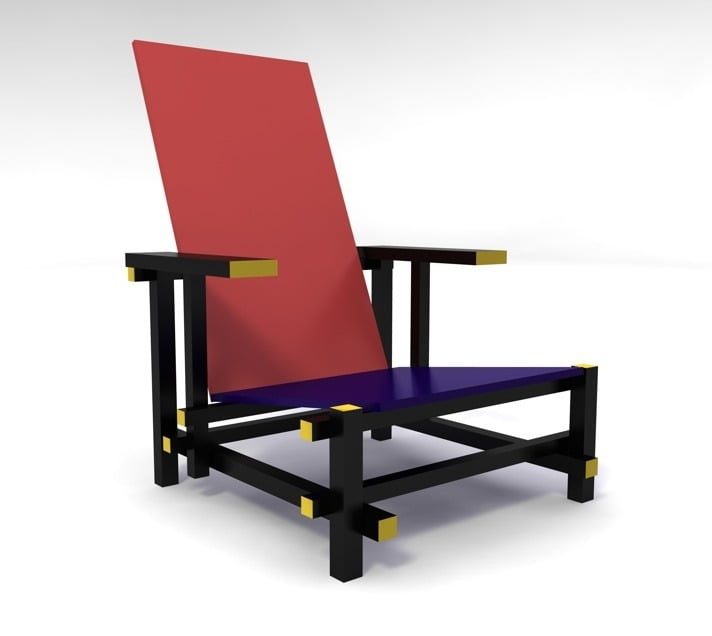
A close look at the structure of the chair makes its principle plain. Straight wooden slats cut to standard dimensions pass over one another; none is embedded in another. Each part can thus be read as a separate element. The colors reinforce this logic: the seat is blue, the back red, the supporting slats black and their ends yellow. Color here is not decoration but a means of explaining the structure. In this respect the chair can be thought of as much as a painting placed in space as an object to sit on. Its first version appeared around 1918, and it acquired its familiar red and blue color scheme a few years later.
Why did Rietveld care so much about mass production?
Mass production was one of Rietveld’s greatest dreams. In his view, designs had to be functional and shaped within geometric consistency. If furniture can be bought by broad sections of the public today, it is thanks to Rietveld’s approach of achieving affordability through mass production.
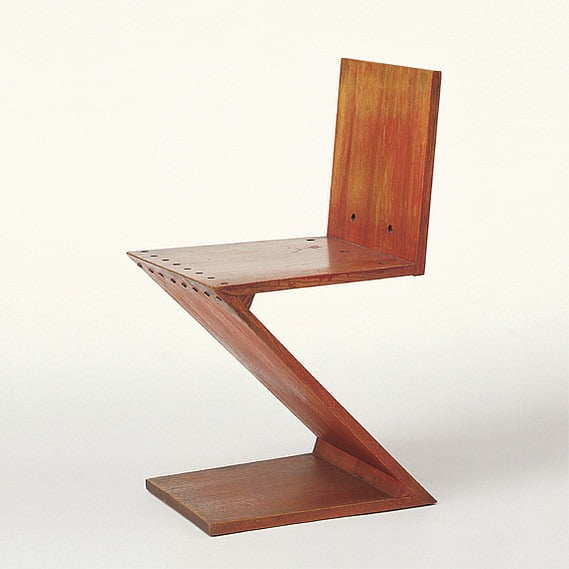
For Rietveld, simplicity was not merely a matter of appearance. Straight slats and standard parts meant furniture could be made with less workshop labor, faster and more cheaply. His goal was to turn beautiful, principled design into something accessible not only to the wealthy but to ordinary people as well. This idea is an early and powerful example of the “good design for everyone” philosophy that would later become central to the Bauhaus school and to modern design in general. In later works such as the Zig-Zag Chair, he continued the same pursuit, the desire to say as much as possible with as few parts as possible.
Why is the Schröder House a turning point?
The designer produced many geometrically planned houses as an architect. But the house known as the Schröder House caused a sensation. In the houses he designed, he this time broke the taboos that architecture had held until then.
Designed for Truus Schröder-Schräder in the city of Utrecht and completed in 1924, this house is the only known example in which De Stijl principles were applied to a building from start to finish. Seen from outside, the house is composed of planes sliding over and past one another and of intersecting lines. Inside, perhaps its most innovative aspect emerges: thanks to sliding and folding partitions, the upper floor can become a single open volume by day and be divided into separate rooms at night. Space is not fixed but something that changes according to the user’s needs. This flexible approach to planning deeply influenced contemporary housing design. The house was added to the UNESCO World Heritage list in 2000. Gerrit T. Rietveld died in the Netherlands in 1964.