
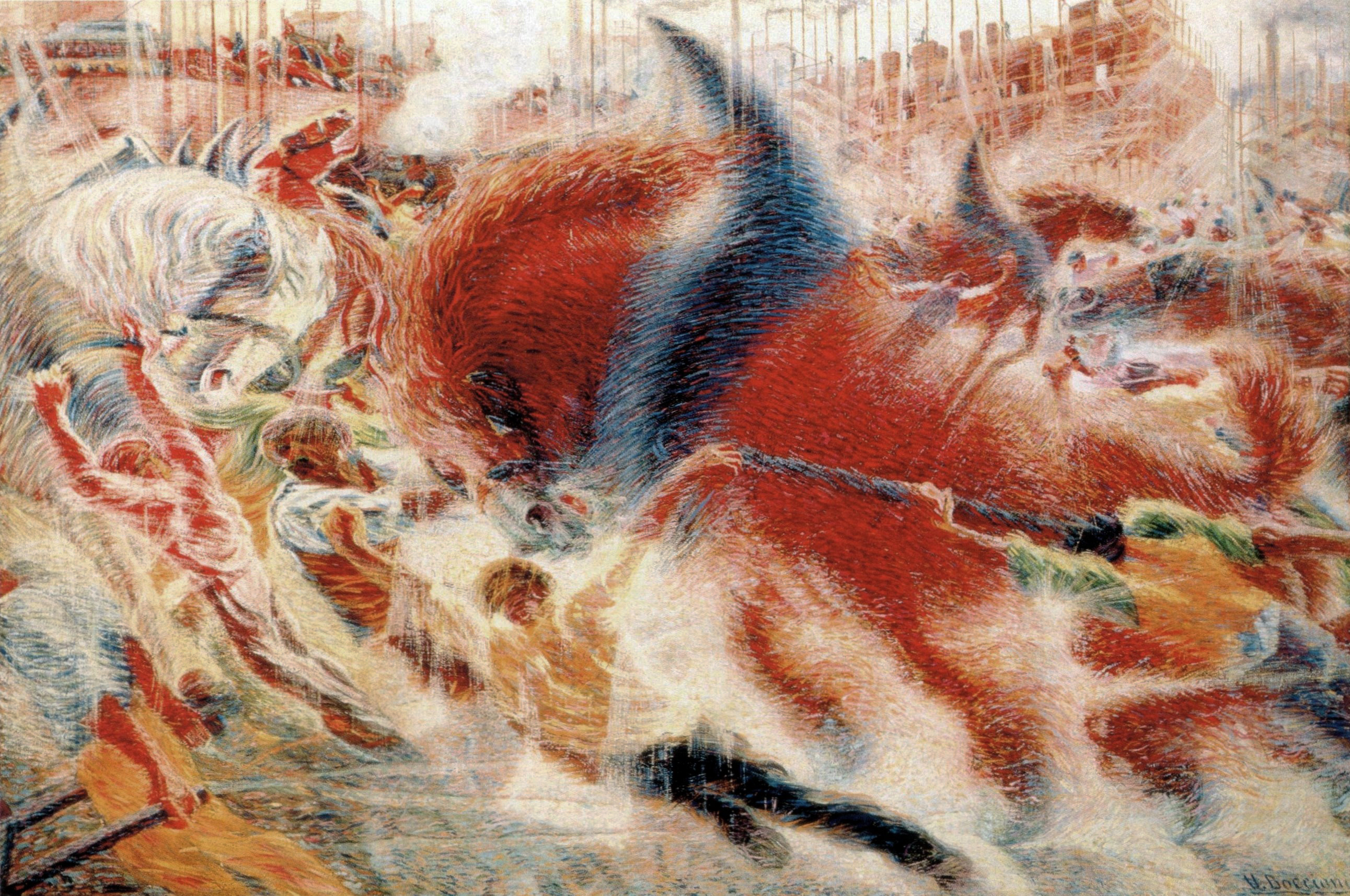
Umberto Boccioni, The City Rises, 1910.
Futurism is an art movement that emerged in Italy at the beginning of the 20th century, glorifying speed, the machine, the modern city and constant motion. Born in an era when industrialization and technology were radically transforming life, the movement regarded reverence for the past as a burden and argued that art should turn toward the future, dynamism and energy. It was influential not only in painting but also in literature, music, architecture and design. In this respect, Futurism was not merely a painting style but a comprehensive cultural movement that carried the technological exuberance of its age into art.
What is Futurism?
Futurism takes its name from its faith in the future. The movement’s starting point is a manifesto published at the beginning of the 20th century. In this text, the symbols of modern life such as the automobile, the train, electricity and the factory were praised, while museums and libraries were criticized for representing the stagnation of the past. For the Futurists, beauty was no longer to be sought in ancient statues but in a machine in motion. In their view, a speeding racing car was more beautiful than a classical sculpture.
At the center of the movement lie the concepts of movement and speed. The artists tried to show not just a static moment of an object but its motion through time on a single surface. The legs of a running figure or the wings of a bird are superimposed in their successive positions to create a sense of movement. This approach was a radical stance that challenged the traditional rules of art and carried the changing sense of tempo of its age directly onto the canvas.
What are the characteristics of Futurism?
The most distinctive feature of Futurist works is the effort to visualize movement. By superimposing the successive positions of a figure or object, the artists created a sense of continuity and speed in the viewer. This technique resembles frames of photography shot in rapid succession. The motion photography of the period was an important source feeding the Futurists’ idea of breaking movement into parts.
Among the movement’s other distinctive features, the following can be noted. Fragmented and sharp forms were used frequently. Strong lines and dynamic angles were preferred in compositions. Colors were generally chosen to be vivid and energetic. Modern urban life, crowds, construction sites, automobiles and industrial scenes are among the favorite subjects.
Futurism took the idea of formal fragmentation from Cubism, but placed it in the service of movement rather than stillness. While the Cubists showed an object from different angles at the same time, the Futurists used the same fragmentation to convey time and motion. They thus combined geometric abstraction with the technological exuberance of their age.
Important Futurist artists and works
The movement’s pioneer and most powerful theorist was the Italian poet and writer Filippo Tommaso Marinetti, who set down the fundamental ideas of Futurism in writing. Marinetti turned the movement from a mere painting style into a comprehensive cultural movement, calling on artists through his manifesto to free themselves from the weight of the past.
In painting and sculpture, the best-known name is Umberto Boccioni. His work The City Rises, shown above, conveys the construction of the modern city and the intense motion of laboring figures and horses with powerful energy. Boccioni’s sculpture Unique Forms of Continuity in Space shows a walking figure as if cutting through the air, carrying Futurism’s understanding of movement into three dimensions.
Among the movement’s other important representatives are Giacomo Balla and Gino Severini. Balla investigated the vibrations of light and movement in forms approaching an abstract language, and gained fame with his work depicting the walk of a dog on a leash through successive legs. Severini treated modern urban entertainment and dynamic subjects such as dance in colorful, luminous compositions. What these artists shared was the desire to paint not a static world but a world in constant motion.
What fields did Futurism spread to?
Futurism was not confined to the canvas. Poetry, theater, music and photography also became fields of experiment for the movement. Marinetti developed an experimental approach to poetry that loosened the rules of grammar and scattered words freely across the page. In music, attempts were made to bring noise and machine sounds into art.
In theater, short, shocking stage experiments emerged that rejected traditional narrative. This versatility shows that Futurism rested not on a single technique but on the ambition to transform the whole of life. The movement was a comprehensive attitude that tried to capture the rhythm of the modern age in every branch of art.
How did Futurism influence today’s design and later periods?
The influence of Futurism was not limited to painting; it also spread to fields such as graphic design, typography and architecture. In particular, the experimental approach to typography, in which texts were placed freely on the page and letter sizes and directions were played with, laid the groundwork for the development of modern graphic design. The Futurists’ dynamic, energetic page layouts, which broke with static order, inspired the next generation of designers. The bold experiments of the movement lie at the roots of today’s posters that energize through tilted, diagonal and moving arrangements.
Futurism’s aesthetic of speed also echoes in product and transportation design. Aerodynamic lines, forward-thrusting forms and lines evoking motion are used in many fields, from automobiles to sports products. In interior architecture, flowing transitions and dynamic orientations are chosen to give a space a sense of motion. The transition animations and motion graphics used in digital interfaces are also, in a sense, a contemporary extension of the idea of motion that the Futurists tried to fit into a single frame.
With its stance centered on movement and energy, the movement also contributed to the development of abstract art and other avant-garde movements. Today, Futurism is regarded in art history as one of the first great visual responses to the age of technology. This outlook, which celebrates the aesthetics of speed and the machine, continues to be an inspiring source whenever movement, dynamism and a future-oriented emphasis are sought in contemporary design.