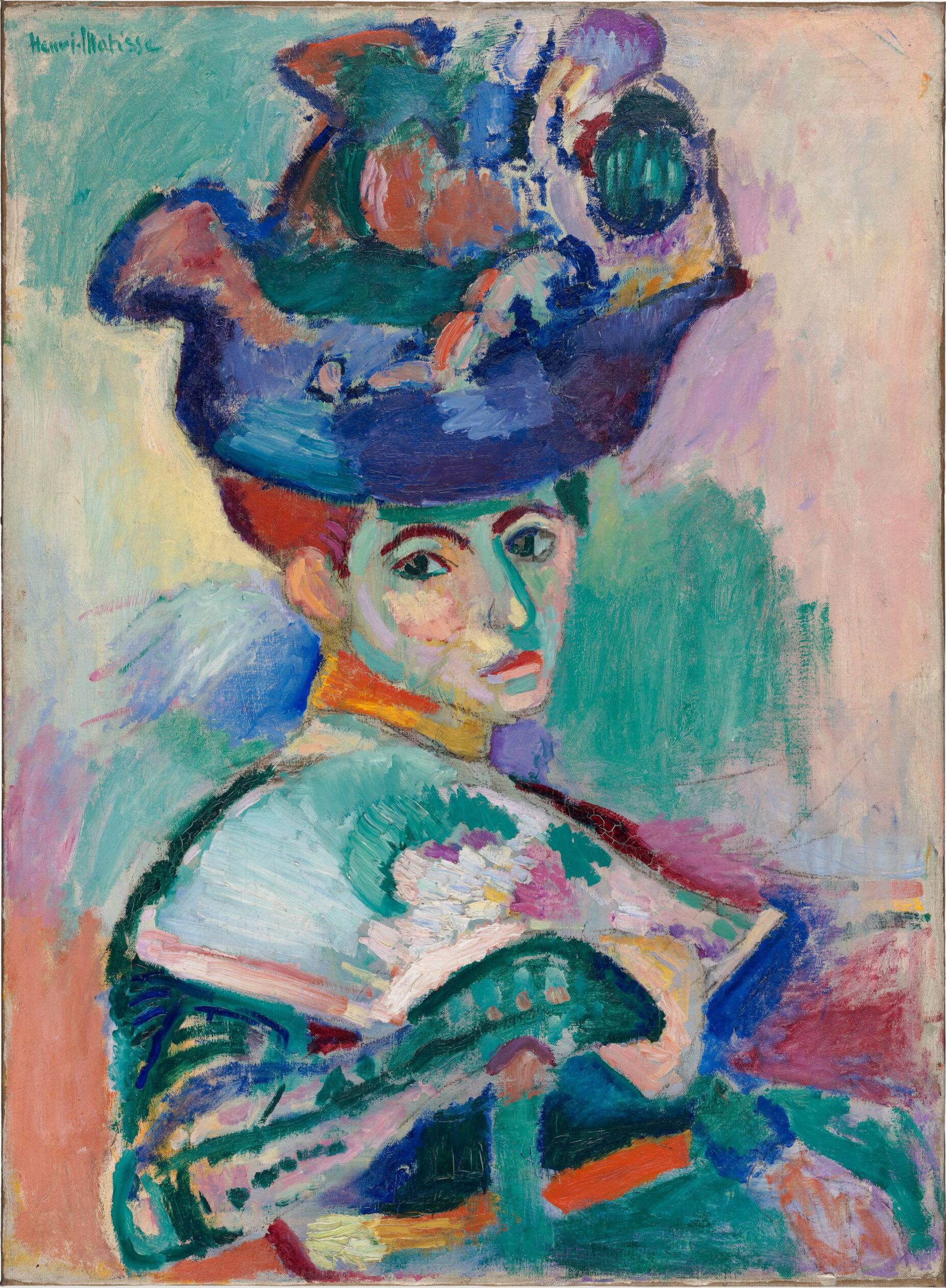
Henri Matisse, Woman with a Hat, 1905.
Fauvism is a short-lived but influential painting movement that emerged in France in the early years of the 20th century, using color in a pure, intense way that is completely independent of how things appear in nature. It takes its name from the French phrase “les fauves”, meaning “wild beasts”. The name was born from the remark of a critic startled by the raw, seemingly uncontrolled colors used by the movement’s artists.
How did Fauvism emerge?
The movement first drew wide attention at the 1905 Salon d’Automne exhibition in Paris. The paintings of Henri Matisse and his friends, shown together, were unusually bright and harsh for audiences of the time. This breakthrough was a natural continuation of the freedom that Impressionism and Post-Impressionism had granted to color. The way Vincent van Gogh and Paul Gauguin in particular used color as a carrier of emotion had a direct influence on the younger generation.
What are the defining characteristics of Fauvism?
What makes Fauvism most distinctive is its approach to color. A sea does not have to be blue, nor a tree green; the artist chooses the color that the composition and the emotion demand. The movement’s key characteristics can be summarized as follows:
- Unnatural, highly saturated and bold colors
- Pure paint, often used straight from the tube without mixing
- Thick, fast and visible brushstrokes
- Simplified forms stripped of detail
- A composition built on color contrast rather than depth and shading
This approach turned painting from a copy of reality into an expression of the artist’s inner world.
Important Fauvist artists and works
The undisputed pioneer of the movement is Henri Matisse. Works such as Woman with a Hat and Le Bonheur de Vivre demonstrate the independent power of color. André Derain carried this bold approach into landscape painting with his views of London and Collioure. Maurice de Vlaminck was known for his energetic brushwork, while Albert Marquet, Kees van Dongen and Raoul Dufy also contributed to the movement’s development. Fauvism was not based on a manifesto or a formal group; it was a movement of artists gathered around a shared attitude.
Why was the movement short-lived?
After an intense beginning, Fauvism dissolved as a movement around 1908. Most of its artists went their own ways. Matisse pursued his search for color and simplicity throughout his life, while Derain turned toward more classical forms. Yet the path the movement opened never closed; this attitude of liberating color from form and reality prepared important ground for Expressionism and the abstract tendencies that followed.
Fauvism’s influence on later periods and today’s design
Fauvism’s most lasting legacy is the idea of treating color as a means of expression and communication in its own right. This understanding appears across many areas of design today. The use of highly saturated, contrasting colors to grab attention in graphic design and poster culture draws directly on this tradition. The fact that a single bold color can represent an entire brand identity is the result of this trust in the symbolic power of color.
Fauvism’s influence also continues in interior and fashion design. Giving a space character with a vivid color, or building a collection around a single strong tone, means using color’s capacity to create atmosphere. Choosing accent colors to guide user attention in digital interface design is a contemporary extension of the same logic. In short, Fauvism reminds the modern designer that color is not mere decoration but a decision that carries meaning.