
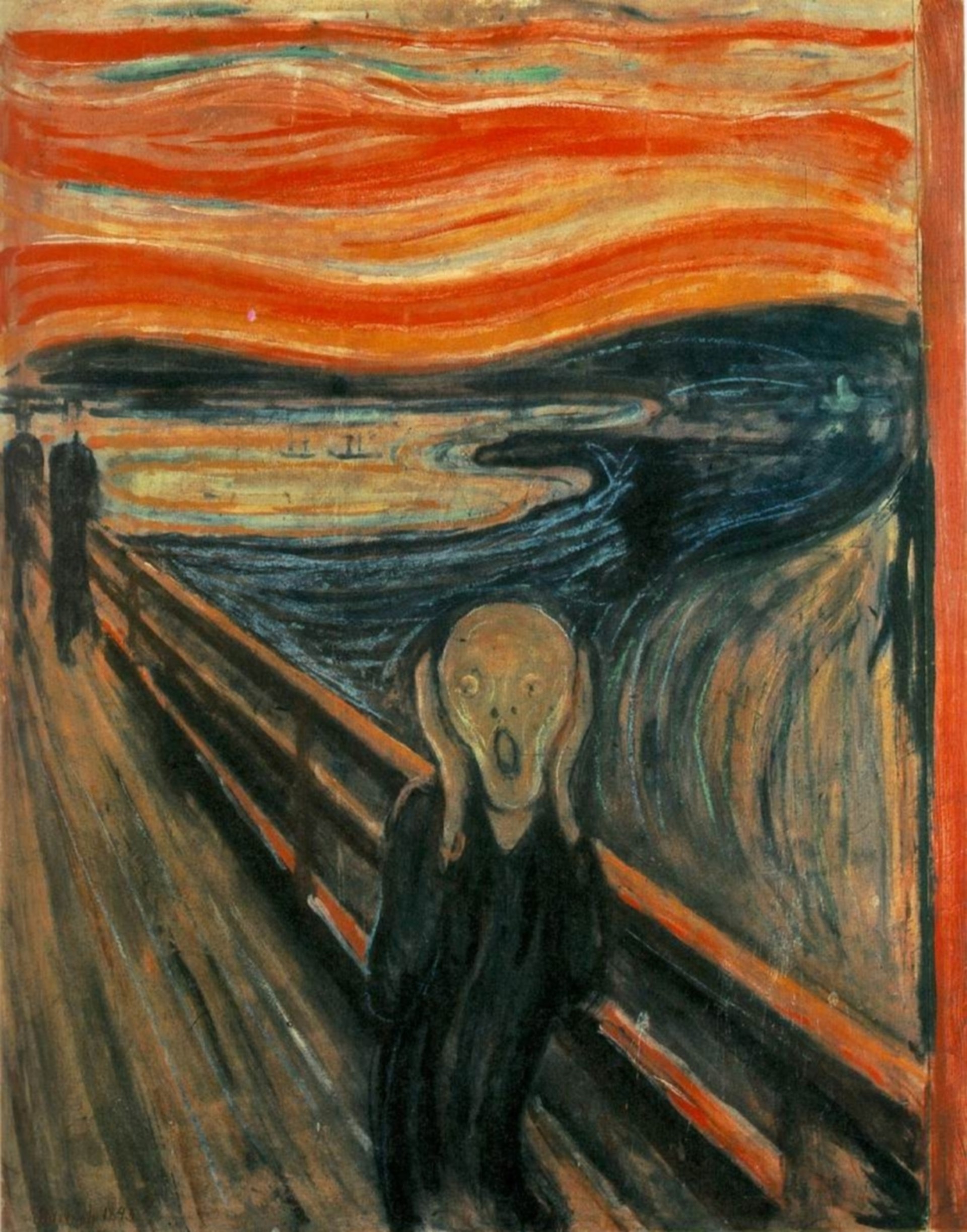
Edvard Munch, The Scream, 1893.
Expressionism is an art movement that developed powerfully in the early 20th century, especially in Germany, in which the artist aims not to depict the outside world as it is but to express their own inner world and intense emotions. The movement filters reality less through objective observation than through a subjective lens of feeling. What matters in this approach is not how a landscape or a person looks, but what feeling it stirs in the artist. Painting thus ceases to be a copy of the world and becomes a state of mind made visible.
What is Expressionism?
At the heart of Expressionism lies the transfer into art of the anxiety, loneliness and tension created by the modern world. The movement takes as its subject the marks that rapidly industrializing cities and a changing way of life left on the human soul. The beginning of the 20th century was a time when the populations of great cities exploded, factories reshaped daily life and the individual became increasingly isolated within the crowds. Expressionist artists sought to make visible the emotions hidden beneath outward appearance: fear, passion, anger, despair.
For this reason, reality is often distorted in Expressionist works. Colors depart from their natural state, forms are exaggerated, perspective is deliberately warped. A face may look paler than it is, or like a mask; a sky may be redder than it could ever be in reality. The goal is not to imitate reality but to turn it into a carrier of emotion. When viewers look at the work, they enter a state of mind rather than watch a scene.
Expressionism can also be read as a reaction to Impressionism, which preceded it. While the Impressionists tried to capture the outward appearance of light and the moment, the Expressionists set aside the appearance of the external world and placed inner experience at the center. In this respect, the movement is one of modern art’s most decisive steps toward subjectivity.
What are the characteristics of the movement?
Expressionist works are known for their strong, direct visual impact. This impact grows out of a deliberate loosening of formal rules. The meticulous sense of measure and proportion of academic painting gives way to a free handling guided by emotion.
The movement’s distinctive features include:
- Unnatural, intense and symbolic use of color
- Exaggerated, distorted or simplified forms
- Strong brushstrokes and an energetic surface texture
- Themes such as anxiety, loneliness, urban life and inner human conflict
- A spatial construction that serves emotion rather than realistic perspective
Edvard Munch’s The Scream, shown at the beginning of this article, brings many of these characteristics together. The undulating sky, the seemingly melting figure and the distorted surroundings make an individual’s moment of intense fear or existential dread almost visible. Munch’s own notes describe this work as a moment when he heard an infinite scream passing through nature, a description that sums up the movement’s outlook. The work is one of the most powerful examples considered a forerunner of Expressionism.
Important Expressionist artists and works
The Norwegian artist Edvard Munch is regarded as one of the movement’s most important forerunners. In works such as The Scream, Madonna and The Dance of Life, he strikingly treated the tension of the inner world, love and the fear of death. In Germany, Expressionism was organized around two important groups of artists.
One of these is Die Brücke, of which Ernst Ludwig Kirchner was a leading founder. Established in Dresden, this group painted the tension of urban life with sharp colors and harsh forms. Kirchner’s paintings of Berlin streets and city dwellers, rendered in tense, angular figures, show the alienating face of modern life.
The other is Der Blaue Reiter, which included figures such as Wassily Kandinsky and Franz Marc. Gathered around Munich, this group focused on the spiritual power of color and form and at times approached abstraction. Franz Marc’s works depicting animals in bright, symbolic colors are beautiful examples of this search. The Austrian Egon Schiele is also counted among the movement’s powerful representatives, with his sharp lines and tense, fragile figures. What these artists had in common was that they saw form not as a record of reality but as an instrument of feeling.
What fields did Expressionism spread to?
The influence of Expressionism was not limited to painting. The movement’s emphasis on emotion also found expression in theater, cinema, literature and architecture. In the German cinema of the period in particular, the atmosphere built with distorted sets and sharp contrasts of light and shadow is a direct reflection of Expressionist thinking. Films such as The Cabinet of Dr. Caligari carried this outlook into cinema with their surreal, tense set designs.
In literature, artists treated the alienation of the individual and the pressure of modern life in intense language. In architecture, curved lines, flowing masses and unusual forms turned buildings into expressions of feeling. Expressionism thus became not a single technique but a broad attitude cutting across many branches of art.
How did Expressionism influence today’s design and later periods?
From the perspective of graphic design, Expressionism’s strong color contrasts, bold forms and emotional intensity left an important legacy to poster design. The desire to convey a message in a plain but striking way is also one of the core concerns of contemporary design. Expressive, hand-drawn and energetic approaches in typography and illustration are rooted in this movement. The rough-textured, distorted letters and intense colors used today on a concert poster or an album cover are a direct extension of this visual language.
The movement’s traces can also be followed in product and interior design. Approaches that value the emotional weight of texture, form and color, in opposition to flat, cold functionality, are kin to Expressionist thinking. The idea that a space should not merely be practical but should also stir a feeling in the person inside it appears frequently in contemporary interior architecture.
By placing the artist’s subjective gaze at the center of art, Expressionism profoundly shaped the course of 20th-century art. The idea that emotion could determine form extended to later movements such as Abstract Expressionism, born in America after the Second World War. Even today, whenever we think that a design should not just convey information but stir a feeling in the viewer, we can see the traces of this outlook. Expressionism reminds us that form always makes us feel something, and that good design manages this feeling deliberately.