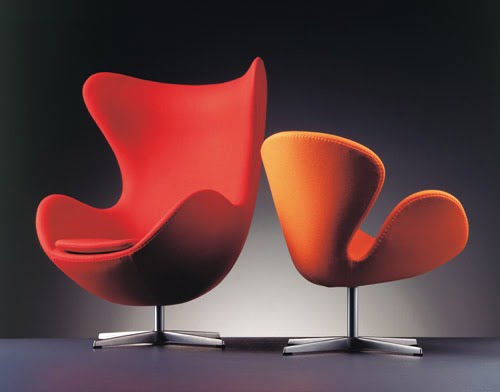
Eero Saarinen was a Finnish-born American architect and industrial designer. Born on 20 August 1910, Saarinen died on 1 September 1961 at the age of 51 in the United States. Through both his large-scale architectural works and his organically shaped furniture designs, he became one of the most influential figures of twentieth-century design.
Saarinen, whose father was also a well-known architect, emigrated to the United States with his family as a child. Growing up in Bloomfield Hills, Michigan, he studied sculpture and furniture design at the Cranbrook Academy of Art, where his father also taught. He studied sculpture in Paris and then architecture at Yale University. His training in sculpture laid the foundation for the flowing, sculptural furniture forms he would later create. After his father’s death, he began to pursue his own design practice independently.
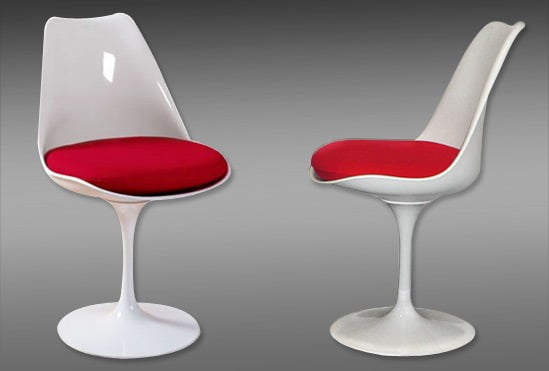
Tulip Chair
What did organic design mean to Saarinen?
Saarinen embraced the idea of organic design early in his career. This approach holds that form should derive not from artificial, mechanical geometries but from flowing, continuous shapes in harmony with the human body and natural forms. For Saarinen, a piece of furniture was not the sum of separately attached parts but an object to be conceived as a single, unified shell.
When this thinking met the new materials and production possibilities of the era, it produced original results. Thanks to moldable plywood and cast materials, Saarinen and his contemporaries were able to produce curved, continuous seating forms that had not been possible before. The chair thus became a shell embracing the human body, and flowing lines took the place of traditional right-angled furniture.
Furniture with organic designs
While working on a chair with his father, Saarinen became aware of an idea that would deeply influence his approach to design. At the “Organic Design in Home Furnishings” competition held in 1940, he was awarded a prize for the molded shell seating solutions he developed together with his designer friend Charles Eames. This work brought forward the idea of treating the seat as a single curved shell shaped to fit the human body, and it became one of the turning points of modern furniture design.
This success carried Saarinen into a long collaboration with the Knoll furniture company, run by Hans and Florence Knoll. Under the Knoll umbrella, Saarinen created many enduring furniture designs. Among them are body-hugging shell armchairs and chairs, and the best known of all, the Tulip series.
Why is the Tulip Chair important?
The Tulip series, Saarinen’s most famous design, was born of his discomfort with the visual clutter created by the four legs of traditional tables and chairs. Saarinen described this by saying he wanted to “clear up the slum of legs” in rooms. As a solution, he developed a form that placed the seat on a single central pedestal. This one-legged structure offered a look that was both visually simple and sculptural.
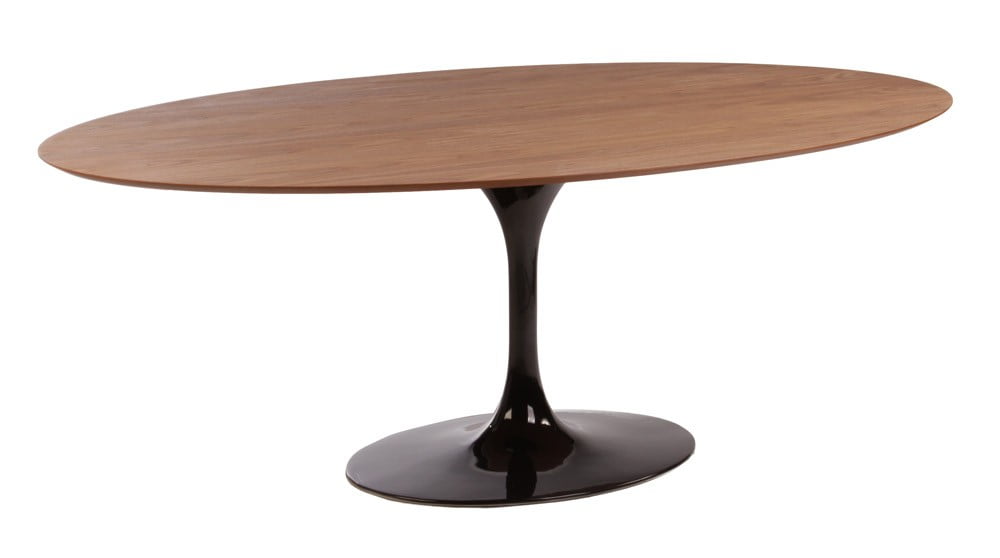
With its flowing, continuous form, the Tulip series is one of the purest expressions of Saarinen’s organic design philosophy. The way the seat shell and the pedestal are perceived as a single whole reflects the designer’s preference for the whole over the parts. Designed together with matching tables, the series formed a unified furniture family and has become a modern design classic still in production today.
Saarinen’s designs beyond furniture
Saarinen’s design practice was not limited to furniture. In architecture, he carried his interest in flowing, sculptural forms into large-scale structures. In projects such as airport terminals and cultural buildings, he used curved concrete shells and continuous surfaces to bring a sense of movement and flow into space. These buildings can be read as the architectural-scale counterpart of the organic design philosophy found in his furniture.
Saarinen was recognized by his professional peers as one of the leading designers of his era and was honored with the most prestigious awards in architecture. Despite his short career, the legacy he left in both industrial design and architecture stands among the strongest examples of what organic form brought to modern design.