
De Stijl is an art and design movement that emerged in the Netherlands in 1917, reducing art to horizontal and vertical lines, right angles and pure primary colors. Its name means “the style” in Dutch and expresses the shared pursuit of the painters, architects and designers gathered around a journal of the same name. The movement was influential between 1917 and 1931 and established one of the most purified visual languages ever to permanently change the direction of modern design.
The technology developing at the beginning of the 20th century, changing social life and the spread of mass media deeply affected art as well. In this period, De Stijl abandoned the concern of depicting reality literally and turned toward the pursuit of a universal harmony. The artists aimed to leave behind the individual and the emotional and to establish a pure, objective visual order that could hold true for everyone.
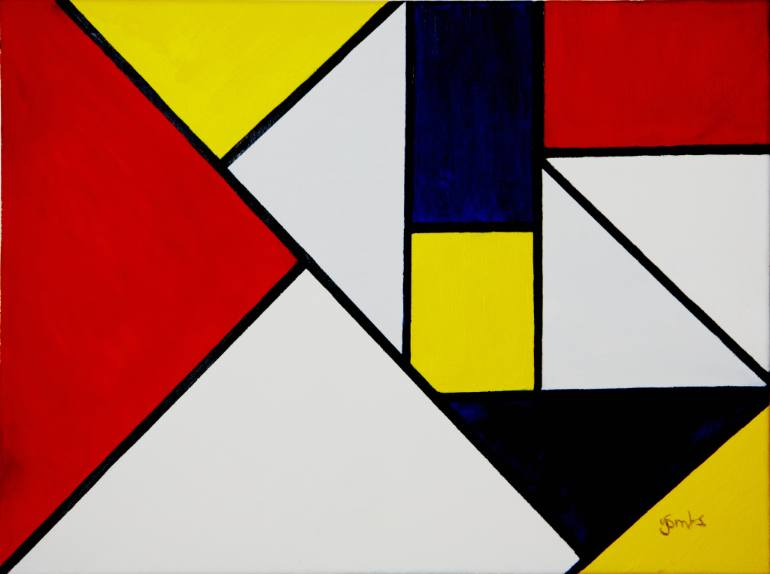
Homage to De Stijl Painting by Yvonne Smits.
De Stijl is the carrier of a design philosophy also known as Neoplasticism. While it drew inspiration from Cubism’s courage in fragmenting form, it carried that fragmentation into a far stricter and plainer order. The movement’s visual language uses only the three primary colors, red, yellow and blue, in compositions where horizontal and vertical lines intersect at right angles. The neutral colors are limited to white, black and gray. Natural forms are abstracted by being reduced to this order, and only the fundamental visual relationships remain.
How did De Stijl emerge?
During the First World War, in the neutral Netherlands, a group of painters, sculptors and architects came together to form a community. This community gave the name De Stijl both to the journal they published and to their own movement. The devastation of the war had driven these artists to dream of a new, harmonious world. In their view, art had to shed personal whim and ornament to reach a universal order, and this order was to serve as the model for a new social life.
De Stijl rejected the emotional, ornate language of all the styles that came before it. It opposed the decorative narration of the Baroque tradition and approaches like Impressionism that prioritized fleeting impressions. In their place, it embraced a calculated, measured pursuit of simplicity. It built meticulous compositions by reducing all elements to flat surfaces bounded by straight lines intersecting at right angles. This attitude did not stop at painting; it was carried into architecture, interiors and furniture as well.

Gerrit Rietveld, Red and Blue Chair, 1917
What is De Stijl’s approach to color and form?
De Stijl’s visual language is extremely restricted, yet all the more powerful for it. The movement reduces the visual world to its most elemental components. Only horizontal and vertical lines are used; curves and diagonals are excluded because they would disturb this universal order. The same purification applies to color. Nothing is used beyond the three primary colors plus black, white and gray. This limitation is not a poverty but, on the contrary, a deliberate pursuit of purity.
The compositions built from these elements rest on balance rather than symmetry. Rectangles and areas of color of different sizes, separated by thick black lines, come together to form a whole that is dynamic yet balanced. Mondrian saw this balance as the harmony of opposing forces. For him, reality in the plastic arts could only be expressed through the dynamic equilibrium between color and form, and this equilibrium could best be achieved with unadulterated, plain means.
Important artists and works
De Stijl is the work of a few powerful figures gathered around a common language. The movement’s best-known representative is the painter Piet Mondrian. At the end of a years-long journey of purification, Mondrian abandoned natural imagery entirely and arrived at compositions consisting only of line, color and plane. His arrangements of red, yellow and blue have become the symbol of the movement.
Another founding figure of the movement is the painter and theorist Theo van Doesburg. Van Doesburg, who founded the De Stijl group and its journal in 1917, was the person who put the movement’s ideas into writing and spread them. In time, he diverged from Mondrian by championing diagonal lines. In architecture, J.J.P. Oud was an important figure who carried the movement’s principles into housing design. The architect and furniture designer Gerrit Rietveld, meanwhile, believed that everything could be reduced to horizontal and vertical lines. His Red and Blue Chair and the Schröder House he designed are regarded as the movement’s purest three-dimensional examples.
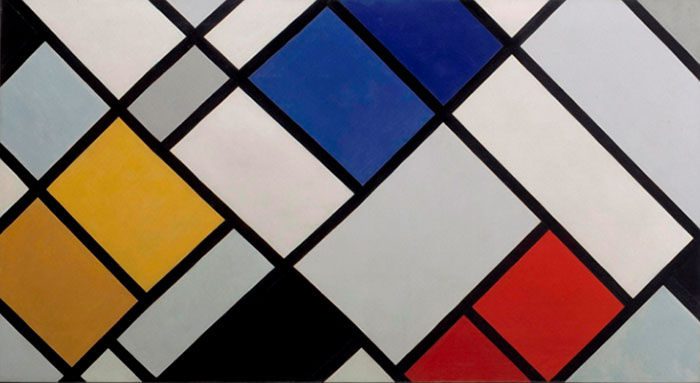
Theo van Doesburg, Counter-Composition in Dissonance 16 (1925)
How did De Stijl influence architecture?
The adaptation of De Stijl to architecture brought a radical change to the way form had been conceived until then. The movement’s architects treated the building not as a closed mass, but as an open composition formed by independent planes coming together. Walls, floors and colored surfaces were arranged like separate elements seemingly suspended in the air. The boundary between interior and exterior thus loosened, and a fluid living space opened up, one flowing into the other.
This approach was also a forerunner of the functionalist architecture that developed toward the end of the 1920s. Opposing the traditional, ornamental conception of architecture, De Stijl is recognized as one of the movements that prepared the plain, geometric language of contemporary architecture. Rietveld’s Schröder House, the best-known building in which these ideas took physical form, still reads like the movement’s manifesto.
Influence on later periods and today’s design
The influence of De Stijl reached far beyond painting and architecture, spreading across modern visual culture as a whole. The movement’s primary color palette, grid logic and geometric simplicity became one of the principal tools of 20th century graphic design. The clean lines, balanced divisions of space and pure use of color we see in a poster or a corporate identity are often directly related to this legacy.
The movement’s disciplined sense of order, together with the Bauhaus, also nourished modern design education. The two movements met in the ideal of building a plain and functional world. The grid systems, modular layouts and limited color palettes we encounter in digital interface design today follow the path De Stijl laid out. Minimalist interiors, geometric furniture and clean corporate brands carry the movement’s lasting influence into daily life.
In this respect, De Stijl is not merely a movement left in history. Its desire to reduce complexity to simplicity and noise to balance endures as an ideal modern design still shares. The visual grammar the movement established a century ago continues to echo across countless surfaces today, from screens to buildings.
Source: