
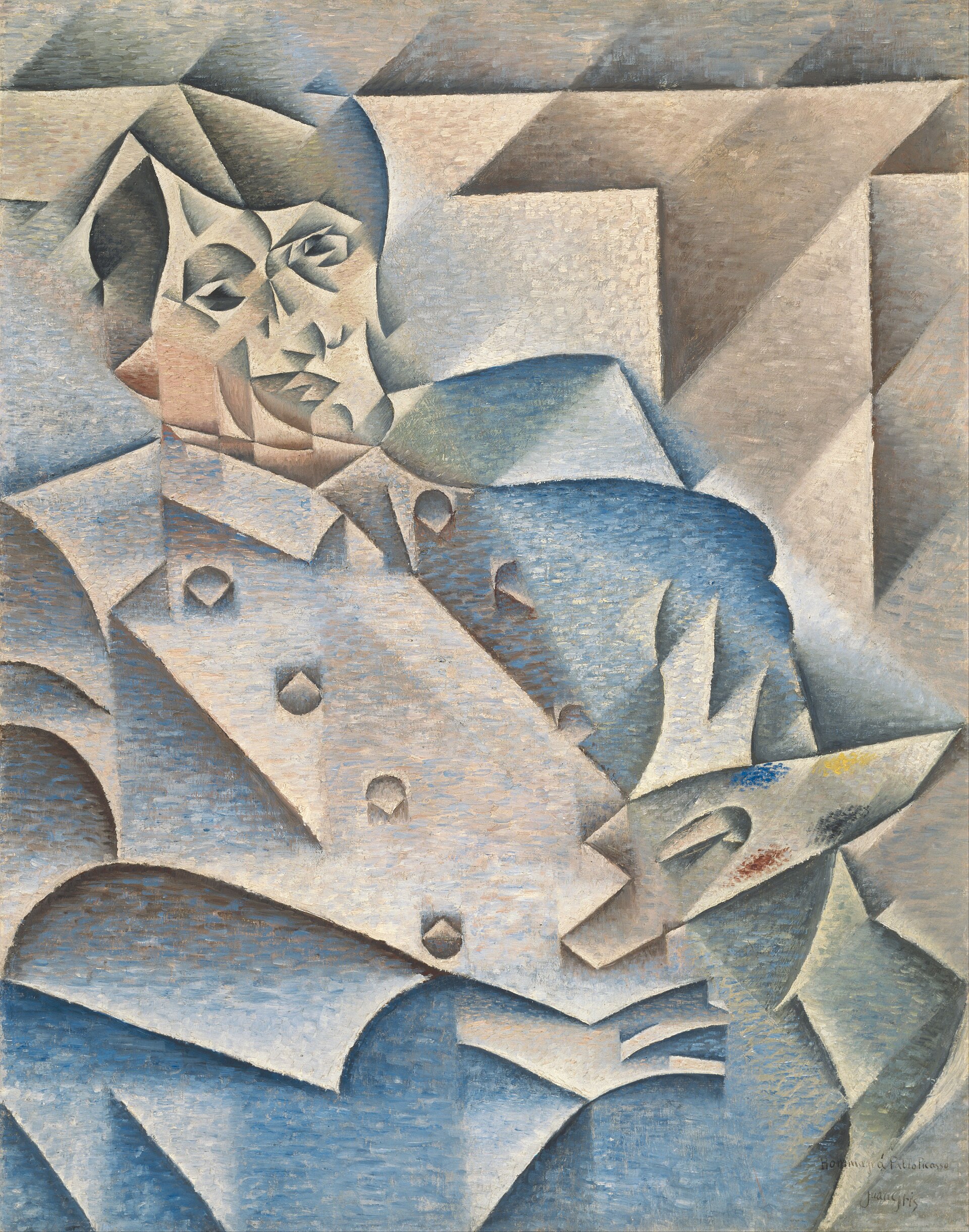
Juan Gris, Portrait of Pablo Picasso, 1912.
Cubism is an art movement that emerged in France at the beginning of the 20th century, breaking objects and figures into geometric parts and bringing multiple viewpoints together on the same surface. This movement shattered the single-point perspective that painting had carried for centuries and reopened the debate on how we see. In Cubist works we can see a face both from the front and in profile, an object both from above and from the side. The viewer thus ceases to be a passive eye looking from a fixed point and becomes an active participant who reconstructs the painting’s fragmented surface in their mind.
What is Cubism?
Cubism sets aside the concern with imitating reality and aims instead to analyze the structure of the object. In traditional painting, the artist tried to render the world as seen through a single window. The Cubists, recognizing that an object is experienced from different angles over time, superimposed these different views on a single plane. The result is a geometric order that at first glance seems scattered but is in fact meticulously constructed.
The birth of the movement is usually dated to 1907, to Picasso’s works in which he boldly fragmented the figure. In those years Paris had become a fertile laboratory where artists were searching for a new way of seeing. The spread of photography pushed artists to seek a purpose beyond copying reality one to one. Cubism became one of the most radical answers to this search.
What is the difference between Analytic and Synthetic Cubism?
The movement’s development is usually treated in two main phases. In the first period, known as Analytic Cubism, objects are broken into small facets, the color palette is restricted to browns, grays and earth tones, and form comes almost to the threshold of abstraction. The aim in this period is to take the object apart and analyze its structure, which is why the paintings read like a kind of visual analysis.
In the later period, known as Synthetic Cubism, the artists turned to plainer, flatter forms. In this phase, the collage technique came to the fore, with real materials such as newspaper clippings, pieces of wallpaper and labels pasted onto the surface. Painting thus became a field that could be built not only with paint but with everyday objects. Color also revived in this period, and compositions gained a more legible order.
What are the defining characteristics of Cubism?
The most distinctive quality defining Cubism is the multiple viewpoint. A figure or object is shown from more than one angle at once, and these views are combined in a single composition. The second important feature is the reduction of form to geometric units. Rounded contours become angular planes, voluminous bodies become flat surfaces.
In Cubist works, the illusion of depth is largely abandoned. Background and foreground interpenetrate, and the object merges with the space surrounding it. Color is often relegated to a secondary role, because the real subject is form itself. This is why the palette is quite restricted in the Analytic period. Another innovation of the movement is the use of collage and mixed materials. The artists’ addition of a real piece of newspaper to the canvas permanently expanded the boundaries of what art could be made of.
Important artists and works
The first two names that come to mind with Cubism are Pablo Picasso and Georges Braque. In the movement’s early years, the two artists worked so closely that some of their works are hard to tell apart. Picasso’s bold experiments in fragmenting the figure, especially his work Les Demoiselles d’Avignon, are regarded as the herald of the movement. Braque’s approach of meticulously weaving the surface gave this bold language balance and discipline.
Alongside this pair, Juan Gris stands out as one of Cubism’s clearest and most orderly interpreters. The Portrait of Pablo Picasso shown above demonstrates how Gris used geometry with a sense of balance and luminosity. Fernand Léger added his own interpretation to the movement; by reducing forms to cylinder-like and tube-like volumes, he carried the rhythm of the machine age into painting, which is why his style is sometimes called Tubism.
Other figures developed around the movement as well. Robert Delaunay, giving weight to color, moved toward a more luminous and musical Cubism. Albert Gleizes and Jean Metzinger became the artists who set down the movement’s theory in writing, explaining and spreading it. Though these artists had very different temperaments, they were pursuing a common question. That question was this: how can an object be shown beyond its appearance.
Why was Cubism so revolutionary?
The importance of Cubism lies not only in producing a new kind of image but in changing art’s fundamental contract. Since the Renaissance, painting had been constructed as a window onto the world. Cubism closed that window and treated the canvas as an object in its own right, a surface with its own rules. Painting thus became less a depiction of the outside world than a structure existing through its own formal language. This stance opened the way for all the abstract and conceptual pursuits that followed.
Influence on later periods and today’s design
Cubism’s influence was not confined to painting; it spread across modern visual culture as a whole. The movement’s logic of fragmentation, superimposition and geometric abstraction nourished many movements that came after it. Futurism drew on Cubist fragmentation to convey movement and speed. Cubism’s courage in freeing form from the object was also decisive in the development of abstract art. Movements such as De Stijl and Constructivism carried this geometric thinking forward in their own languages.
In the field of design, Cubism’s traces are especially strong. Geometric order, plain forms and the relationship between planes became fundamental tools of 20th-century graphic design and the language of the poster. The collage technique opened the door to a new understanding of composition in both typography and modern editorial design. In architecture and furniture design, the pursuit of geometric simplification coincided with the structuralist tendencies of the period.
The roots of the fragmented, layered and geometric arrangements we encounter today in a logo, a cover design or an interface can largely be found in the path Cubism opened. In many fields, from product packaging to digital interface design, the logic of dividing an image into planes and layering different pieces of information on the same surface draws directly on this legacy. In this respect, the movement endures not merely as a painting style but as a fundamental grammar of modern seeing and modern design.