
What does the Bauhaus art movement mean?
The Bauhaus is a school and design movement founded in 1919 in the German city of Weimar, aiming to unite art, craft and industrial production in a single design philosophy. Its name means “house of building” in German, reflecting the movement’s ideal of seeing the building as the common ground where all the arts meet. The Bauhaus should be understood not merely as an educational institution, but as an intellectual movement that shaped the aesthetics of modernization.
Although many people think of the Bauhaus as merely an architectural style, the movement’s influence spread across a much wider swath of life. Traces of the Bauhaus can be found in many fields, from furniture to typography, from posters to everyday household objects. This pursuit of uniting industrialization with art permanently changed the direction of 20th century design.
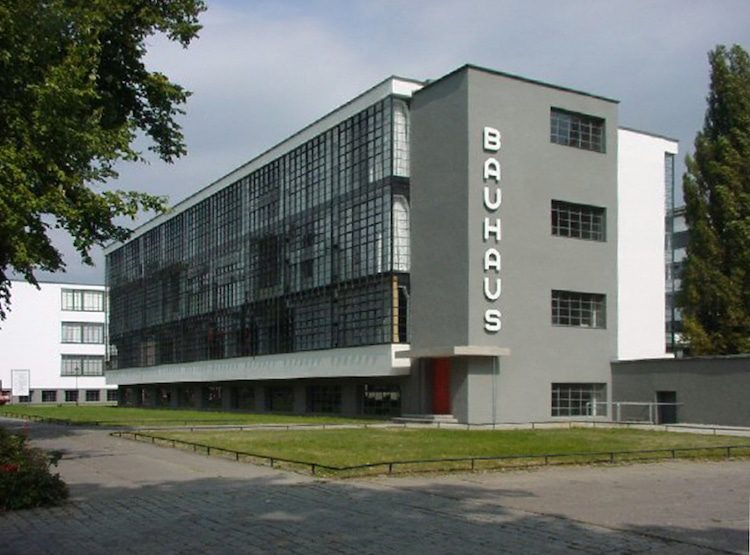
Bauhaus Dessau (Photo: Mewes via Wikimedia Commons)
From its founding to its closure, the school operated in three cities. It was based in Weimar from 1919 to 1925, in Dessau from 1925 to 1932, and finally in Berlin from 1932 to 1933. This geographical journey also reflects the movement’s process of maturing. The Dessau period in particular is regarded as a productive phase in which the school applied its own principles in their purest form.
Who founded and who directed the Bauhaus school?
The Bauhaus school was founded in 1919 by the architect Walter Gropius. Gropius believed that postwar Germany needed a new approach to design. In his view, the products of the age had to be more functional, more durable and more accessible. He therefore devised a holistic educational model that intertwined painting, architecture, craftsmanship and sculpture. For Gropius, the artist stood at the highest rung of craftsmanship, and true design could only be born from the fusion of these disciplines.
After its founding, the school saw three important directors. Following Walter Gropius, the school was led for a time by Hannes Meyer. His tenure brought a focus on social function and production. Mies van der Rohe, who later took over, established a more disciplined structure grounded in architecture. In 1933, the school was closed under pressure from the Nazi regime. Paradoxically, this closure accelerated the movement’s spread across the world. Many teachers who left the school emigrated to the United States and passed Bauhaus thinking on to new generations there.
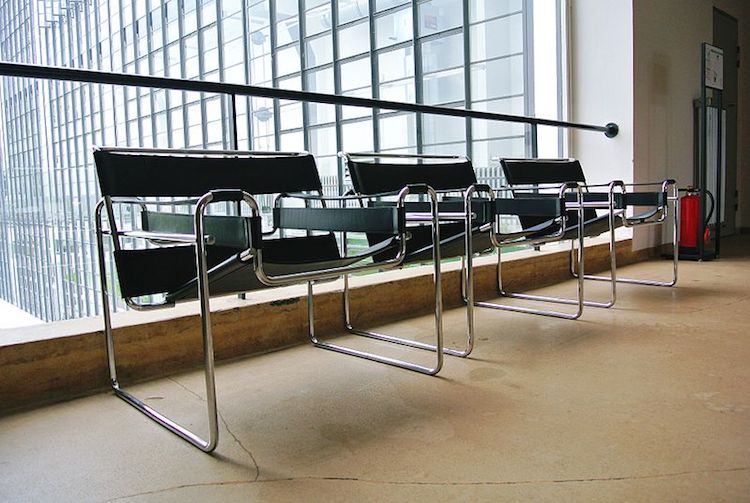
Photo: pyrosdrakopoulos via Wikimedia Commons
What are the fundamental principles of the Bauhaus?
At the heart of the Bauhaus lies a philosophy of functionality. According to the movement’s core idea, an object should first be designed for its purpose, and beauty should arise naturally from that function. This approach rejects unnecessary ornament and simplifies form as much as possible. This is why straight lines, elementary geometric shapes and clear proportions appear so often in Bauhaus designs.
Another important principle is the effort to eliminate the divide between art and craft. Rather than seeing these two fields as separate, the Bauhaus aimed to unite them in a shared practice of making. Education at the school proceeded not through theoretical lectures in the classical sense, but through hands-on production in workshops. Students came to know materials directly by working in wood, metal, glass, textile and ceramics workshops.
The idea of the foundation design course also first took shape at this school. Students were asked not to imitate someone else, but to discover material, color and form through their own experiments. The foundation design courses taught in design and architecture schools around the world today draw directly on this Bauhaus tradition.
What is the relationship between the Bauhaus and architecture?
For the Bauhaus, architecture was the highest ground on which all the arts met. The ultimate goal of every discipline was to design the space people live in as a whole. Architectural education at the school was therefore treated together with furniture, lighting, typography and interior design. To design a building meant not merely erecting walls, but conceiving the life inside it from beginning to end.
In time, Walter Gropius gave the school a dedicated department of architecture, where urban design, construction, planning and technical drawing were treated together. Under the directorship of Mies van der Rohe, architecture moved to an even more central position. Bauhaus architecture, with its horizontal lines, wide glass surfaces, flat roofs and facades stripped of ornament, became the herald of modern architecture. The school building in Dessau is one of the best-known examples of this approach.
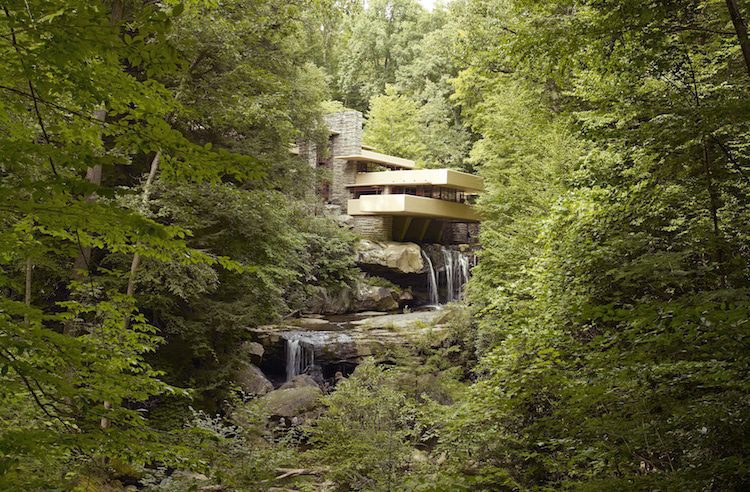
Photo: Carol M. Highsmith via Wikimedia Commons
Important artists and works
The Bauhaus was the joint product not of a single master, but of a powerful teaching staff. The school’s founder Walter Gropius built the movement’s framework with his vision as both administrator and architect. Mies van der Rohe, who carried the philosophy of “less is more” into architecture, deeply influenced the language of modern building.
In painting and color, Wassily Kandinsky and Paul Klee were the two great figures who shaped the school’s foundation design courses. Kandinsky’s theoretical lectures on color and form are also considered among the foundations of abstract art. László Moholy-Nagy brought an innovative visual language to the school through his experiments in photography, typography and new media. Marcel Breuer became a pioneer of industrial furniture with his tubular steel chairs, particularly the design known as the Wassily Chair. Anni Albers, who ran the textile workshop, transformed weaving into a contemporary design discipline.
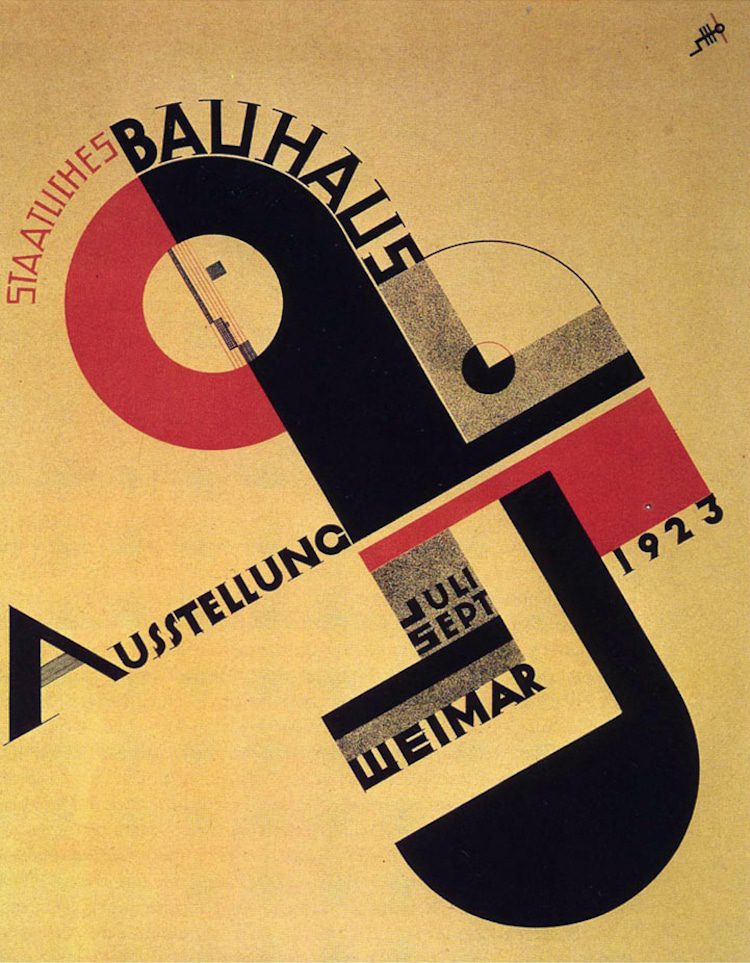
Bauhaus Exhibition Poster (1923) (Photo: iv toran)
Influence on later periods and today’s design
The influence of the Bauhaus did not end with the school’s closure; on the contrary, its true expansion came afterward. The teachers who emigrated to America continued the movement’s principles in new institutions there, and this thinking quickly turned into an international design language. The plain, functional language of the modern architecture that shaped the world’s great cities after the Second World War draws largely on the Bauhaus legacy.
In graphic design, the traces of the Bauhaus are especially strong. Clean layout, grid systems, sans serif typography and the use of elementary geometric forms became the basic tools of modern corporate identity design. In industrial design, the principle that function determines form remains the leading tenet of product design today. The idea of the plain, useful object suited to mass production is directly tied to this tradition.
Perhaps the most lasting influence of the Bauhaus is in education. Approaches such as workshop-based learning, direct experimentation with materials and the foundation design course form the backbone of design schools around the world today. From the pursuit of simplicity in digital interface design to minimalist household objects, the echo of the principle “form follows function” can be heard in countless fields. In this respect, the Bauhaus is not a movement left in the past, but a still-living grammar of modern design.
Source:
The Art Story, Bauhaus
Bauhaus: How the Avant-Garde Movement Transformed Modern Art